// SPACE.COM — SPAZIO & SCIENZA
This genuinely pocket-sized smart telescope makes capturing the deep sky and the solar system almost effortless
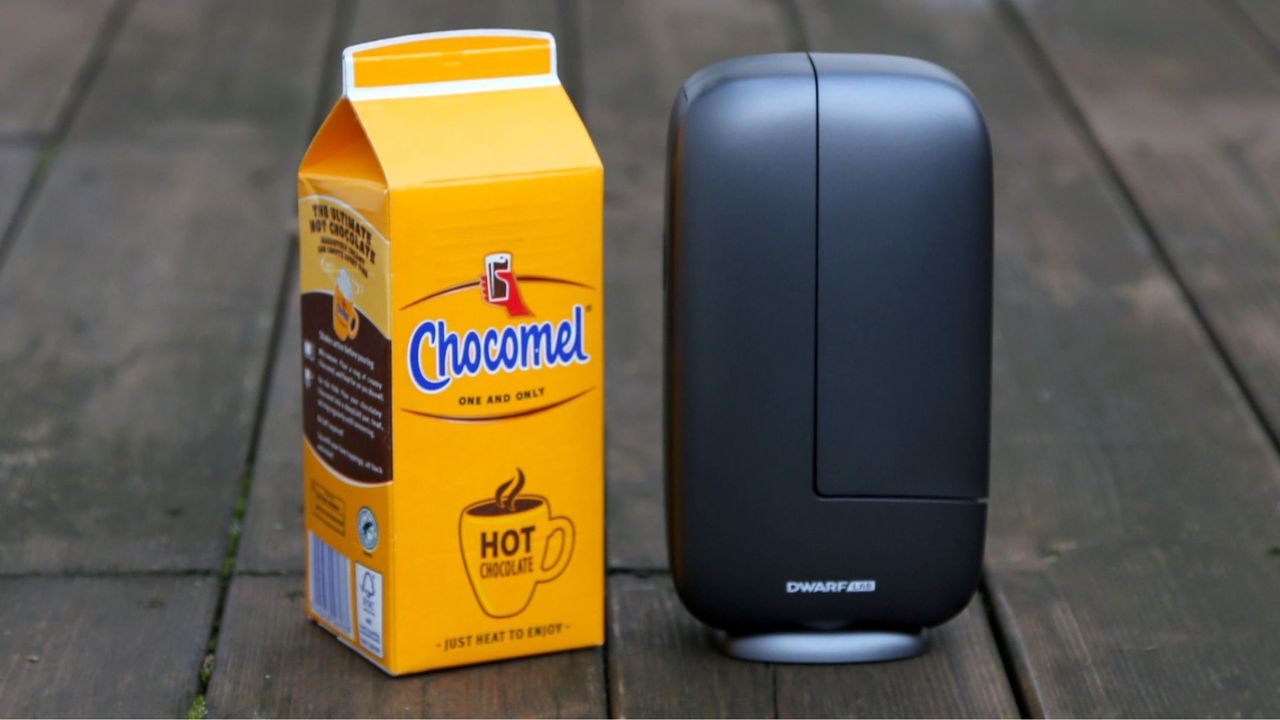
Small enough to slip into a jacket pocket yet capable of capturing nebulas, star clusters and sunspots, this smart telescope is nevertheless designed for convenience rather than ultimate image quality.
Why you can trust Space.com
Our expert reviewers spend hours testing and comparing products and services so you can choose the best for you. Find out more about how we test and review products.
The best smart telescopes have transformed astrophotography over the past few years, combining small telescope optics and automated mounts with dashcam-style camera sensors and image-processing software. The result? Compact devices that can be controlled entirely from a smartphone. Impressively, the DwarfLab Dwarf Mini pushes that concept even further.
Roughly the size of a thick paperback book, it’s one of the smallest smart telescopes yet produced — tiny enough to fit in a jacket pocket while still capable of imaging nebulae, star clusters, the moon and even sunspots. It's also one of the best telescopes for beginners.
Positioned below the larger Dwarf 3 in DwarfLab’s lineup, the Mini sacrifices aperture and resolution for portability. It uses a 30mm refractor paired with Sony’s IMX662 sensor and relies on automated stacking to gradually reveal deep-sky objects. The telescope connects to a phone via Wi-Fi or Bluetooth and handles alignment, tracking and imaging automatically through the DwarfLab app.
With built-in filters, optional equatorial tracking, and advanced software features such as Mega Stack and Stellar Studio processing, the Dwarf Mini is aimed at beginners and traveling astrophotographers who want a compact, automated imaging system that doesn’t require lots of extra kit — and works well even in light-polluted cities.
The defining characteristic of the Dwarf Mini is its size. The body includes a 360-degree rotating base and an articulating lens arm that moves through 225 degrees, allowing the telescope to cover most of the sky. It's significantly smaller than its competitors, including the larger Dwarf 3, making it easy to pack for travel. In fact, it’s easily small enough to slip into a camera bag or carry-on luggage, making it an appealing option for traveling astrophotographers — perhaps including eclipse chasers preparing for the upcoming trio of total solar eclipses beginning in 2026, since a magnetic solar filter is included in the box. Nice touch!
The telescope itself is a 30mm f/5 refractor with a focal length of 150mm. This produces a field of view of about 2.4 degrees, roughly five times the apparent diameter of the full moon. That optical system is paired with a Sony IMX662 sensor, a 1/2.8-inch sensor capable of 2.1MP resolution (1080p). This sensor is all about low noise and sensitivity, making it well-suited to short astrophotography exposures, but not to high-resolution images. Compared with the Dwarf 3’s Sony IMX678 Starvis 2 sensor, which delivers 8.3MP and 4K resolution, the Mini is a step down in terms of detail. However, in practice, the difference is smaller than expected, particularly after image stacking and processing.
Field of view: 50.59 x 45.06 degrees (wide)/2.5 x 2.14 degrees (telephoto)
The device also features a motorized internal filter wheel, allowing users to switch between broadband and dual-narrowband filters directly in the app to mitigate light pollution and better image nebulae. This avoids the need to install external filters, which are an add-on accessory with some smart telescopes.