// ARS TECHNICA — MOBILE & WEB
Among the large new rockets Amazon was counting on, only Europe has delivered
“As for Arianespace, they have definitely stepped up.”
Amazon now has hundreds of flight-ready satellites standing idle in Florida, waiting to join the company’s low-Earth orbit Internet constellation, an Amazon official said Tuesday.
“They’re built, and sitting in a payload processing facility waiting for trips to orbit,” said Steve Metayer, vice president of Amazon Leo Production Operations, during a teleconference with reporters. “And we’re currently manufacturing several satellites a day.”
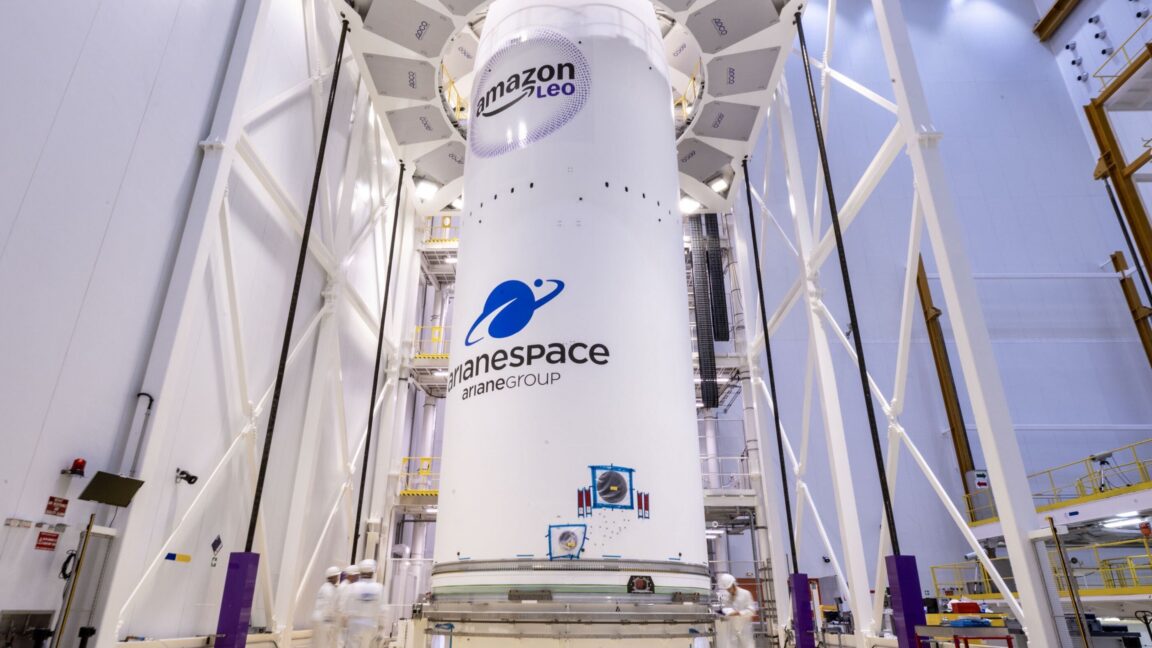
Metayer spoke on the eve of the company’s next mission, during which an Ariane 64 rocket will launch three dozen Amazon Leo satellites into orbit from a spaceport in French Guiana. Liftoff is targeted for 7:53 am ET (11:53 UTC) on Wednesday.
France-based Arianespace has emerged as a critical partner for Amazon, which, to date, has had the majority of its 331 satellites launched on Atlas V rockets. However, Amazon has just one more mission booked on this rocket, which is operated by United Launch Alliance, as the vehicle is slated for retirement.
To launch the majority of its Leo constellation, Amazon booked rides on three large, new rockets four years ago: 18 launches on the Ariane 6 rocket, 12 launches on Blue Origin’s New Glenn rocket, with options for 15 additional launches; and 38 launches of the United Launch Alliance’s Vulcan rocket.
But of these new rockets, only Arianespace has delivered so far, with two launches completed this year, another on Wednesday, and more to come. Neither New Glenn (also owned by Amazon founder Jeff Bezos) nor Vulcan has launched Amazon satellites yet.
“As for Arianespace, they have definitely stepped up,” Metayer said. “They’re very reliable on their manifest dates, and they’re very reliable and safe on their insertions into orbit. So we definitely would continue to look forward to the next 16 launches with them on our existing contract, and we see them being a player long-term beyond that.”
Amazon originally planned to reach a high flight cadence by the mid-2020s. While its satellite manufacturing business has delivered, a serious launch bottleneck remains. Only about 10 percent of the company’s planned 3,236 satellite constellation has been deployed to date.
Recently, the company withstood another setback when the New Glenn rocket exploded during a test firing on its launch pad in Florida. This accident in late May destroyed the rocket and severely damaged the New Glenn booster’s only launch pad. Bezos has said New Glenn will return to flight this year, but most independent industry observers believe it will require 12 to 18 months to restore the Launch Complex 36A launch pad.