// ARS TECHNICA — MOBILE & WEB
Space Force-backed mission does its best impression of Top Gun in orbit
“Dogfighting in space doesn’t quite have the drama of an aerial dogfight.”
An ongoing military exercise happening hundreds of miles above Earth has—for the first time in an unclassified setting—demonstrated how future satellites might evade and pursue one another in a future conflict.
That was the announcement Wednesday from True Anomaly, one of the companies involved in the exercise. True Anomaly’s Jackal satellite, also known as Panther, played the cat-and-mouse game with another spacecraft named Puma, based on Rocket Lab’s Pioneer satellite platform.
“This is what we’ve really been building towards for the past four years,” said Even Rogers, True Anomaly’s co-founder and CEO.
The two satellites, each somewhere between the size of a dishwasher and a refrigerator, are part of the Victus Haze mission managed by the US Space Force. Victus Haze is the latest in a series of “responsive” Space Force missions aimed at demonstrating how the military and its commercial contractors can rapidly launch and deploy new satellites in reaction to an emerging threat or need.
The scenario for Victus Haze, set in motion earlier this year, involved the launch of True Anomaly’s Jackal satellite in May. Rocket Lab’s Puma satellite, already built and in storage, was on standby to quickly launch when it was time to start the exercise. Rocket Lab was on call to launch its Puma spacecraft within 24 hours of call-up by the Space Force.
That happened last month, when military officials informed Rocket Lab it was time to go. The company quickly rolled its Electron rocket and Puma satellite to a launch pad in New Zealand and launched them June 19, less than 17 hours after receiving the call-up. Within 38 hours, Rocket Lab had fully activated and prepared the Puma satellite for its first orbital maneuver, beating the Space Force’s requirement of 72 hours.
The launch set up Puma for a series of burns to move in close to True Anomaly’s satellite. The Space Force’s criteria for success was to complete the rendezvous and photograph the target satellite in less than 84 hours. Rocket Lab reported it did the job in less than 59 hours, culminating in a head-to-head inspection and survey, with each satellite snapping pictures of the other.
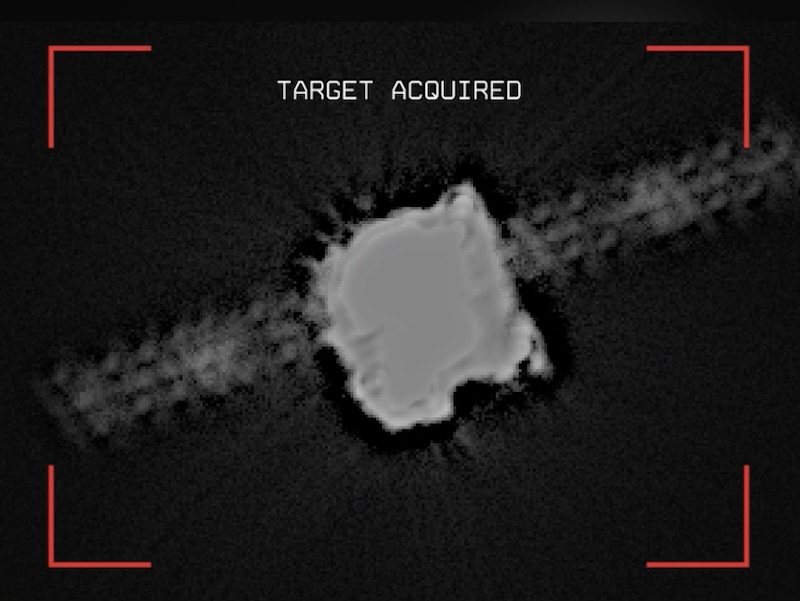
One of the images, released by Rocket Lab, shows its satellite’s view of True Anomaly’s Jackal.
“You can see that we are actively tracking them,” Rogers told Ars. “Our solar arrays are deflected, tracking the sun, and we are staring right down their boresight, which is just a really cool demonstration of our capability. We were tracking them while they were tracking us, and maintaining power-positive status.”