// ARS TECHNICA — MODA & SOCIETÀ
How fruit flies chase invisible ribbons of smell to get to their source
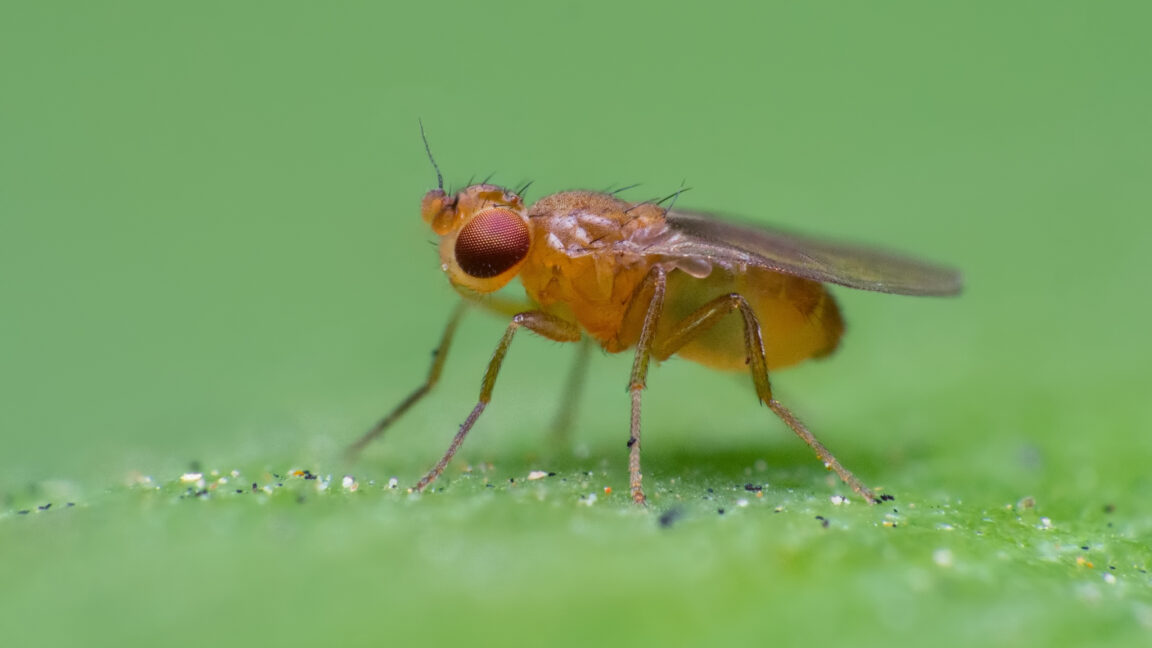
Tracking smells in turbulent air takes a keen sense of direction and sharp memory.
A fruit fly hunting a piece of rotting fruit or a mate navigates by smell, following plumes of odor. Out in the wild, turbulent air swirls these plumes into a chaotic, broken landscape—dense chemical filaments laced through long stretches of clean air. A fly trying to find the source gets the smell in stutters, from constantly shifting directions, with no guarantee that a next whiff is coming at all.
Scientist had little idea of how fruit flies manage this chaotic signal with a brain the size of a pinhead. For a long time, biologists stood by the “surge and cast” model, which posited that insects solved this with hardwired reflexes. The idea was that, when a fly registers the plume with olfactory neurons in its antennae, it simply flies upwind until it’s gone and then flies side to side attempting to catch it again. But now a team led by Vanessa Ruta, a neuroscientist at the Rockefeller University, has shown that fruit flies do something far more advanced.
The trouble with the traditional surge and cast model is that it struggles to explain how an insect tracks a meandering plume across long distances. Chemical cues floating in the air in the natural environment are often sparse and unreliable. But those same features make the mechanism behind olfactory navigation notoriously difficult to test. “Odors are invisible,” Ruta says, “and often they’re carried along by turbulent airflow.” We’ve got no way of knowing what the animal is smelling from one moment to the next.
So, Ruta’s team designed an experiment to learn that. Scientists tethered a fly (Drosophila) in place over a small ball floating on a cushion of air in complete darkness. “It’s a little fly-sized treadmill,” Ruta explains. As the fly walked on the surface of the ball, its turns steered a nozzle that blew a steady stream of air at its antennae, so the insect always felt wind coming from a fixed direction, as if it were walking across an open field. Then the researchers piped apple cider vinegar into that airstream, switching it on and off depending on the fly’s position on this virtual field.
This way, the researchers could precisely control the intensity and direction of the odor the fly was registering. “We could actually generate any kind of arbitrary chemical landscape,” Ruta says. The team could simulate a lifelike olfactory experience with turbulent plumes, straight-edged corridors, and gradients of smell running backwards. “It’s actually not a very complicated virtual reality system, but it is actually extremely powerful,” Ruta adds.
For once, the experimenters knew the identity and quantity of every molecule the fly was receiving. The first thing they tested was the surge and cast model. And it did not hold up well.
In the experiment with a straight corridor of vinegar about 50 millimeters wide, flowing with the wind, the flies did not do the obvious thing and march up the middle. Instead, they hugged one edge, riding it through a repeating two-step process. The moment a fly crossed into the odor, it would whip around and move back out, loop through the clean air outside, then make a beeline back to the boundary. The team called it edge tracking.
The flies also spent far more time loitering outside the plume than inside it, even though nearly all their forward progress toward the source happened during those brief dips into the scent. “Flies will track meters along the edge of a plume and never cross over,” Ruta says.
The first explanation the researchers came up with was that the flies were climbing a rising gradient of odor toward the source. But they didn’t do that either. When the team reversed the gradient, so the vinegar grew fainter as the fly advanced, the flies tracked the edge just as well.