// ARS TECHNICA — MONDO
Research roundup: 6 cool science stories we almost missed
Also: Cyborg diving suits for cockroaches, why sleepy sperm whales blow bubbles, Betelgeuse’s companion star.
It’s a regrettable reality that there is never enough time to cover all the interesting scientific stories we come across. So every month, we highlight a handful of the best stories that nearly slipped through the cracks. July’s list includes outfitting cyborg cockroaches with a tiny diving suit for navigating flooded terrain; confirmation that a Medici duke died of malaria, not poisoning; the best evidence to date that Betelgeuse is orbited by a companion star; and evidence that some ancient Egyptian princesses were skilled archers.
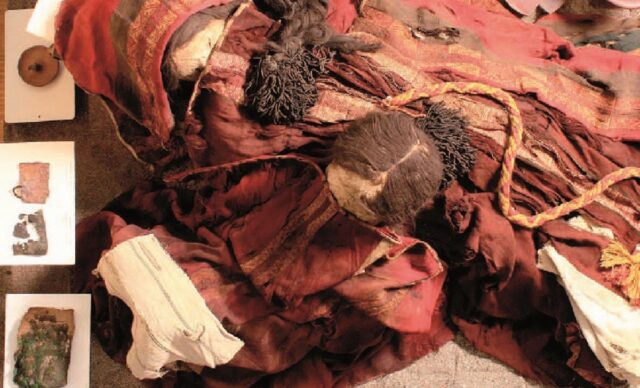
It’s known that the Incas practiced a human sacrifice ritual known as Capachoca, in which children were offered to the mountains and believed to become divine themselves, serving as intermediaries with the gods. This often involved pilgrimages to the remote sacrificial sites, with colonial accounts describing strangulation, asphyxiation, and blunt force trauma as the most common methods of sacrifice. Archaeologists have reanalyzed the remains of one such victim and concluded the boy died from blunt force trauma, rather than freezing to death as previously believed. They described their findings in a paper published in the journal Science Advances.
The Boy of Cerro El Plomo, as he is known, showed no evidence of freezing prior to death, or any cold-related injuries to his extremities. But there was a left frontal skin lesion and associated fracture likely suffered just before death, since there was no evidence of healing. The injury is consistent with blunt force trauma rather than an accidental fall, with a star-shaped mace being the most likely weapon. The plantar surfaces of the boy’s feet showed evidence of prolonged walking over a long distance, consistent with making a pilgrimage to a sacrificial site. CT scans showed a full stomach, suggesting the boy had feasted before the sacrificial ceremony, as well as a dilated esophagus consistent with vomiting. The latter could have been triggered by the head injury.
The team also analyzed the remains of two young girls found at another site, Cerro Esmeralda, previously believed to have died by strangulation. While they weren’t able to identify an exact cause of death because of the condition of the remains, the authors concluded that the marks on the two girls’ necks were not consistent with strangulation and were more likely caused by textiles, i.e., clothing. CT scans showed that the hyoid bones were still intact with no evidence of fractures and in their correct anatomical position.
Science Advances, 2026. DOI: 10.1126/sciadv.adz9055 (About DOIs).
Late 19th century archaeologists excavated the Dahshur pyramid complex within the Memphis Necropolis in Egypt and found several intact burial chambers containing the remains of King Hor and Princess Noub-Hotep, among others. This was soon followed by the excavation of two more burials of Princess Ita and Princess Khenmet, and then Princess Itaweret and Princess Sathathormeryt. A paper published in the journal Frontiers in Environmental Archaeology describes the latest multifaceted re-assessment of those remains, concluding that the princesses were likely skilled at using the weapons buried with them.
The authors combined osteological analysis with X-ray imaging and relied on FTIR spectroscopy to analyze the embalming materials. While the princesses’ skulls had been lost, and some of the bones had not been preserved, the rest of the bones were in good condition. Princess Ita, they determined, died between the ages of 24 and 28 and had strong upper-body muscle attachments, suggesting habitual use of maces or daggers. Princess Khenmet was in her late 30s or 40s and also had strong ligament attachments. Princess Itaweret was between 20 and 34, with healed broken ribs and foot fractures, and her bones showed evidence consistent with being skilled at archery.
“We found pronounced development in