// NATURE NEWS — SPAZIO & SCIENZA
Amygdala astrocyte primary cilium mechanisms contribute to stress behaviours
Nature
(2026) Cite this article
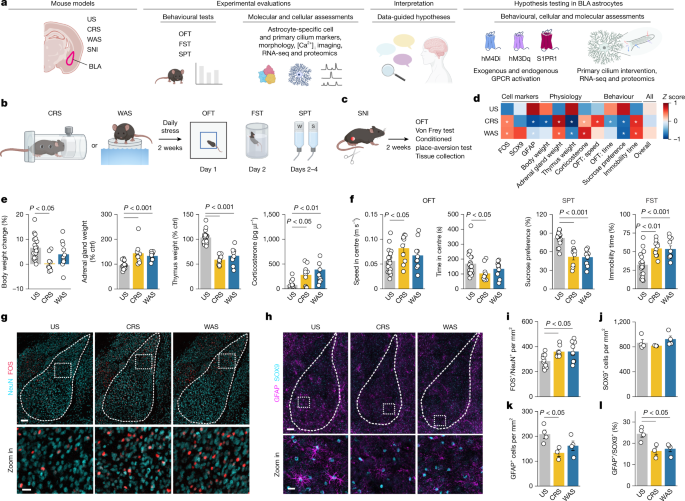
Understanding how adverse life events trigger stress-related behavioural changes remains an unresolved challenge. The amygdala is integral to emotion and stress responses1 and comprises astrocytes, neurons and other cells. Here we show that amygdala astrocytes contribute to stress-related behaviours through signalling mechanisms related to their primary cilia2. Amygdala astrocytes are altered during stress at the protein and gene expression level, display reduced expression of molecules related to primary cilia3,4 and have morphologically short primary cilia5,6. G protein-coupled receptors (GPCRs) are central to astrocyte7 and primary cilia2,8,9 function. Therefore, we speculated that GPCR signalling activation might be beneficial in stress-related behavioural disorders. We identified amygdala astrocyte GPCRs as regulators of responses following stress. Chemogenetics and targeting of native sphingosine-1-phosphate receptor 1 (S1PR1) GPCRs led to the restoration of astrocyte primary cilia length, corrected molecular alterations and improved stress-related behaviours. Cilium-related genes were abundantly expressed in human amygdala astrocytes, with many displaying disrupted expression in stress-related brain disorders. S1PR1 was also highly expressed in amygdala astrocytes from human tissue. Selective genetic disruption of amygdala astrocyte primary cilia in mice altered some stress-related behaviours and gene expression of astrocytes and parenchymal cells. These data confirm that astrocytic cilia have important roles in this brain nucleus. In summary, amygdala astrocytes and their primary cilia are disrupted during stress, and their restoration is accompanied by stress-related molecular and behavioural improvements. Astrocyte primary cilia-related mechanisms may therefore provide new treatment strategies for stress-related and other brain disorders.
Unravelling the mechanisms that link adverse life events to stress-related behavioural changes and disorders such as depression and anxiety represent an unmet goal of neuroscience. Important advancements have identified several brain regions associated with stress-related disturbances of emotion, reward and cognitive function, including the basolateral amygdala (BLA)1,10,11,12. The BLA has a crucial role in associative learning, particularly for fear and reward, by encoding emotional valence of stimuli and by influencing motivated behaviours. The BLA is activated by stress and is altered in conditions of pathological stress1,10,11,12. However, the molecular and cellular basis of stress-related changes in the amygdala are not well understood. Moreover, because many past studies have focused on neurons, the contributions of non-neuronal cells such as astrocytes to stress-related behaviours remain incompletely explored13.
Astrocytes, a type of glial cell, are crucial components of neural circuits and have essential roles in physiology and disease14. Recent studies have shown that astrocytes are altered in psychiatric disorders and in animal models of psychiatric disorders15,16,17,18,19,20,21,22,23,24,25. These findings underscore the importance of exploring whether astrocytes contribute to stress-related pathophysiological processes in the central nervous system (CNS). Amygdala astrocytes are altered in rodent models of stress26, and both astrocytes and neurons contribute to amygdala function25,27,28,29,30,31. Stress-related behavioural disorders represent a major unmet clinical need32, but the possibility that amygdala astrocytes can contribute to and be used for new therapeutic strategies remains largely unexplored.
The primary cilium is an antenna-like membrane protrusion adorning cells that integrates extracellular cues and serves essential roles in signalling2,8,9,33. Relatively little is known about astrocyte primary cilia5,34,35; however, their deletion causes molecular and developmental changes5. In this study, we