// NATURE NEWS — SPAZIO & SCIENZA
A tumour-derived organoid biobank maps cancer gene dependencies
Nature
(2026) Cite this article
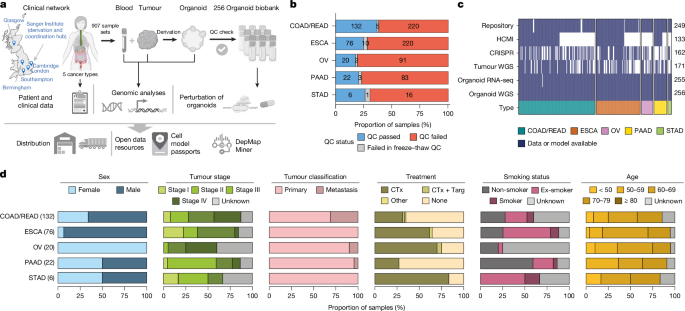
Cancer cell lines remain foundational for research and drug discovery, yet they incompletely capture tumour diversity, lack linked patient context, and have undergone adaptation to culture. Tumour organoids are three-dimensional cultures derived from patient tissue that offer a powerful complement to cell lines1. Here we derived and characterized 256 clinically annotated tumour organoids directly from colorectal, oesophageal, ovarian, pancreatic and gastric cancers as renewable, genetically stable models. Extensive characterization of each model and matched patient tumour samples included whole-genome and transcriptome sequencing, and genome-wide CRISPR–Cas9 screens across 162 organoids mapped gene dependencies. Integrative analyses revealed genomic and clinical markers of dependency across common and rare subtypes, identified organoid-specific essential genes, and revealed targetable vulnerabilities following tumour evolution in paired pre- and post-treatment samples. In colorectal cancer, functional and pharmacological interrogation of the EGFR–RAS–MAPK axis uncovered differential effects of KRAS variant alleles. This open, publicly available resource provides a systematic map of gene dependencies in patient-derived organoids, expanding the model diversity and mechanistic insight needed to advance precision oncology.
The multi-omics characterization of hundreds of 2D cancer cell lines and their perturbation in pharmacological and genetic screens2,3,4,5,6,7,8,9 has been used to build reference maps of cancer dependencies to inform precision cancer medicines. However, the widely available set of around 1,000 human cancer cell lines9 has limitations, including biased representation of certain cancer subtypes or absence of others, no patient-matched germline genetic data for accurately calling somatic variation, and a lack of linked patient characteristics or clinical data. Furthermore, most cell lines adapt to in vitro culture in ways that are not well understood, and reference patient-matched tumour samples are unavailable for comparisons, collectively hampering their use for pre-clinical research and discovery. Patient-derived xenograft models capture elements of the tumour microenvironment, but require specialized facilities and substantial resources, limiting broader use.
Tumour organoids are 3D cultures derived from patient tissue grown with niche factors in an extracellular matrix. They can be derived with higher success rates, capture inter-tumour heterogeneity and better reflect tumour histological, genetic and functional features than cell lines (reviewed in ref. 1). However, scientific, technical and practical constraints have limited their widespread adoption10. Existing biobanks are relatively small (the two largest academic collections include 115 and 96 models), limiting representation of tumour diversity and so do not capture tumour heterogeneity11,12. Many lack comprehensive genomic annotation, with only limited or partial molecular characterization, restricting links to clinical data and systematic evaluation of their fidelity to parent tumours. Some organoids are non-renewable or short-term cultures not suitable for biobanking13,14, and others have restrictive ethical approvals that limit access. Finally, it is unclear whether a large, heterogeneous biobank of tumour organoids, given their greater complexity in culture compared to cell lines, can support systematic mapping of cancer vulnerabilities.
Here we report results from an extensive enterprise in the UK, in partnership with the Human Cancer Model Initiative (HCMI), to derive a highly annotated renewable tumour organoid biobank as an open community resource, and demonstrate its utility for mapping cancer dependencies to inform precision cancer medicine.
To create an organoid biobank, we established a network of five clinical sites in Birmingham, Cambridge, Glasgow, London and Southampton t