// NATURE NEWS — SPAZIO & SCIENZA
DCAF11-dependent molecular glue degrader activated by glutathionylation
Nature
(2026) Cite this article
Targeted protein degradation is a powerful pharmacological strategy that harnesses the ubiquitin proteasome system to eliminate disease-relevant proteins, including otherwise undruggable proteins1. Here we report an unbiased and broadly applicable platform for the systematic discovery of molecular glues across diverse E3 ligases. Using multiplexed mass spectrometry-based chemical screening, we identified M12, a molecular glue that reprogrammes the E3 ligase DCAF11 to degrade DDX18. Mechanistically, M12 functions as a prodrug that is activated through glutathione S-transferase-mediated glutathionylation. The glutathione moiety binds to an evolutionary conserved glutathione-binding site on DCAF11, and the exposed M12 moiety facilitates neo-substrate recruitment. We demonstrate that this glutathione-dependent mechanism readily enables targeted degradation of a range of proteins. Collectively, these findings establish that metabolically activated compounds can redirect E3 ligase function, thereby expanding the scope of targeted protein degradation and chemically induced proximity.
Molecular glues represent a distinct class of small molecules that promote or stabilize protein–protein interactions through modulation of the contact surfaces2. A subset of molecular glues induces protein degradation through recruitment of a neo-substrate to an E3 ubiquitin ligase, causing drug-induced ubiquitylation and subsequent degradation3. This mechanism of drug action was first observed in studies of thalidomide and related drugs, including lenalidomide and pomalidomide, which function as molecular glue degraders for the Ikaros family transcription factors4,5. Degradation of these targets, which were previously considered undruggable, results in clinical efficacy for the treatment of multiple myeloma and other haematologic malignancies4. Mechanistically, these degraders bind to CRBN, a substrate receptor of the CUL4–RBX1–DDB1–CRBN (CRL4CRBN) ubiquitin ligase6. When bound to CRBN, these drugs remodel the surface of CRBN to promote neo-substrate recruitment for targeted degradation7,8. Chemical diversification of the glutarimide-containing compounds that bind CRBN has led to the discovery of dozens of CRBN neo-substrates and led to several new clinical programmes9, highlighting the potential of molecular glues to target a wide range of proteins. Several investigational agents, including aryl sulfonamides and UM171, exhibit a mechanism of action analogous to that of thalidomide by inducing neo-substrate degradation, targeting RBM39 and the CoREST (corepressor of RE1-silencing transcription factor) complex, respectively10,11,12,13.
Motivated by the therapeutic potential, several rational approaches have been pursued to discover molecular glue degraders. By integrating cytotoxicity data with E3 ligase expression profiles across cancer cell lines, CR8 was revealed as a molecular glue degrader for cyclin K14. Through an orthogonal approach, a chemical screen in hypo-neddylated cells uncovered molecular glue degraders for RBM39 and cyclin K15. In addition, diversifying ligands targeting CUL2–ELOB–ELOC–VHL (CRL2VHL) ubiquitin ligase has facilitated the identification of molecular glues targeting CDO1 and GEMIN3 (refs. 16,17). Despite these advances, only a small subset of E3 ligases have been successfully co-opted for neo-substrate degradation. With more than 600 E3 ligases encoded in the human proteome, expanding the range of exploitable ligases will broaden the target space of molecular glue degraders. The principal bottleneck, however, is the lack of unbiased, scalable approaches to systematically identify molecular glue degraders across diverse E3 ligases without relying on ligase-specific compound libraries or prior knowledge of ligase–substrate interactions.
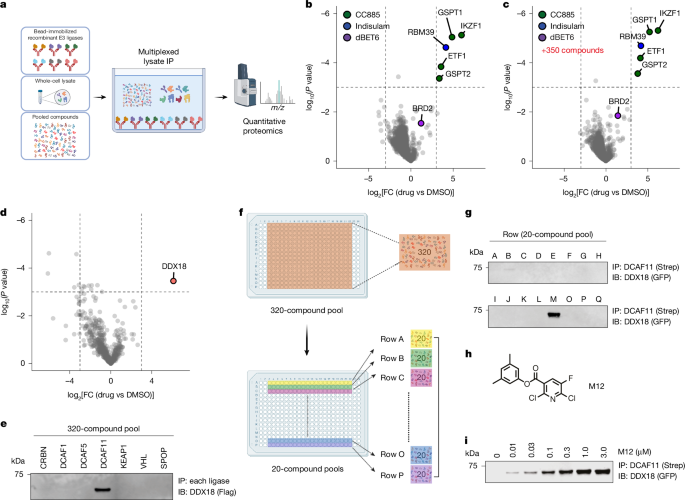
In this study, we developed a high-throughput workflow for the unbiased discovery of molecular glues by mass spectrometry. Multip