// PC GAMER — GAMING
Asus ROG Swift PG32UCWM review
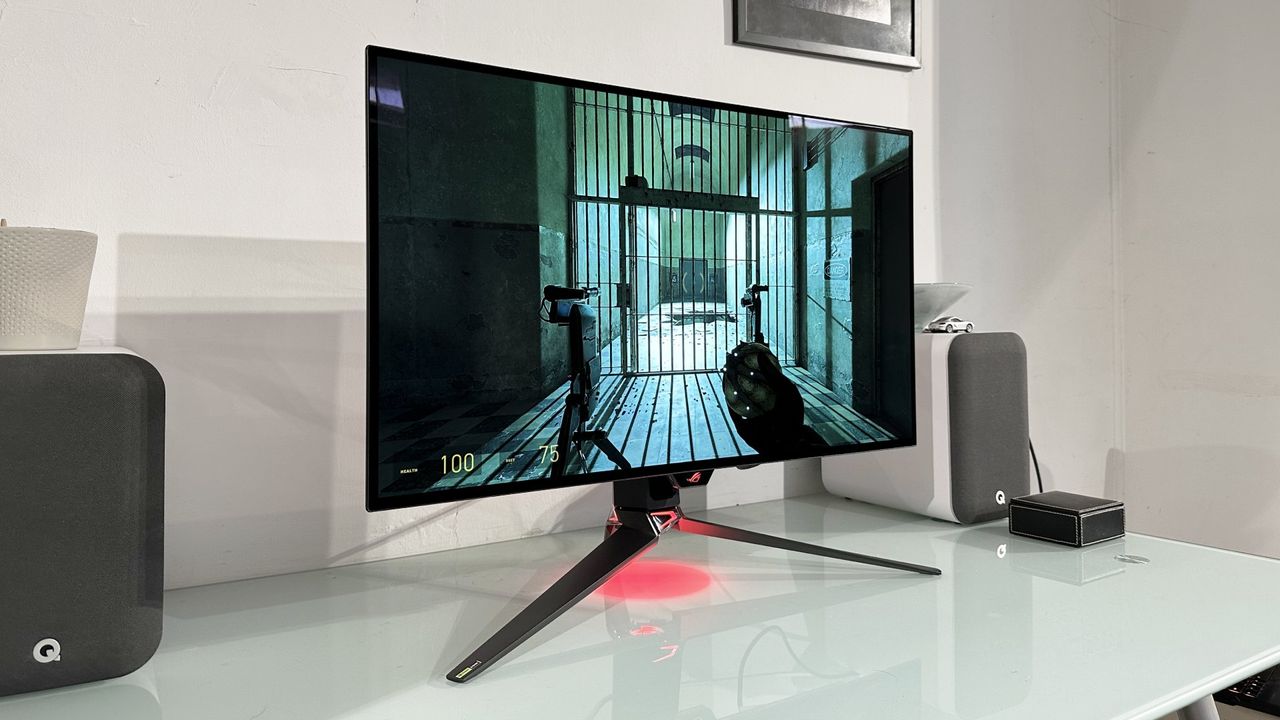
Asus's latest 4K OLED gaming monitor doesn't just pack LG's latest Tandem WOLED tech. It adds an RGB-stripe twist. The results are very, very good. But OLED perfect still hasn't quite been achieved.
PC Gamer's got your back
Our experienced team dedicates many hours to every review, to really get to the heart of what matters most to you. Find out more about how we evaluate games and hardware.
Every time a new OLED gaming monitor comes out of late, it seemingly poses pretty much the same question. Is this the one, is this the model that effectively "completes" the task of gaming monitors, that represents 2D panel technology perfected? Give it up, therefore, for the latest candidate, the Asus ROG Swift PG32UCWM, a 32-inch 4K model.
There's a lot to keep up with when it comes to OLED panel technology developments, but big news here is the inclusion of a new LG Tandem WOLED panel with RGB-stripe subpixel structure. We've already seen LG's Tandem WOLED tech in 32-inch 4K trim recently in another Asus monitor, the Asus ROG Strix XG32UQWMS. But that didn't get the RGB-stripe version of the new panel type, instead retaining the additional white subpixel LG has long used to boost brightness in an "RGWB" configuration.
In theory, then, this new panel has it all. You get the very latest LG Tandem WOLED panel generation with all the benefits that brings, but applied to a pure RGB-stripe subpixel structure. That's it then, job done, the perfect OLED gaming monitor?
LG RGB-stripe Tandem OLED panel, G-Sync, 2x HDMI 2.1, DisplayPort 12.1, USB-C with 90 W PD
✅ You want the most precise RGB-stripe experience: Asus has gone for the RGB-stripe version of LG's new Tandem WOLED tech and it's super precise in just about every way.
❌ You want the absolute brightest OLED monitor: That RGB-stripe panel tech comes at a slight cost in terms of brightness.
Not quite. It's not all pros with this RGB-stripe panel. There are some cons, too, at least on paper. The RGB-stripe subpixel structure—or red, green and blue subpixels arranged vertically in that order—should mean more precise rendering, especially for elements like fonts that rely on addressing the panel at subpixel level to achieve maximum crispness. It also promises more accurate colours and a wider overall colour volume, too.
However, LG has been using the white subpixel on all of its previous OLED panel generations for PC monitors for a reason. And the consequence of removing it is that this RGB-stripe 32-inch Tandem WOLED panel has lower full-screen and peak HDR brightness ratings than its RGWB cousin.