// NATURE NEWS — SPAZIO & SCIENZA
Shared principles of human and bacterial antiviral immunity
Nature
volume 656, pages 307–319 (2026) Cite this article
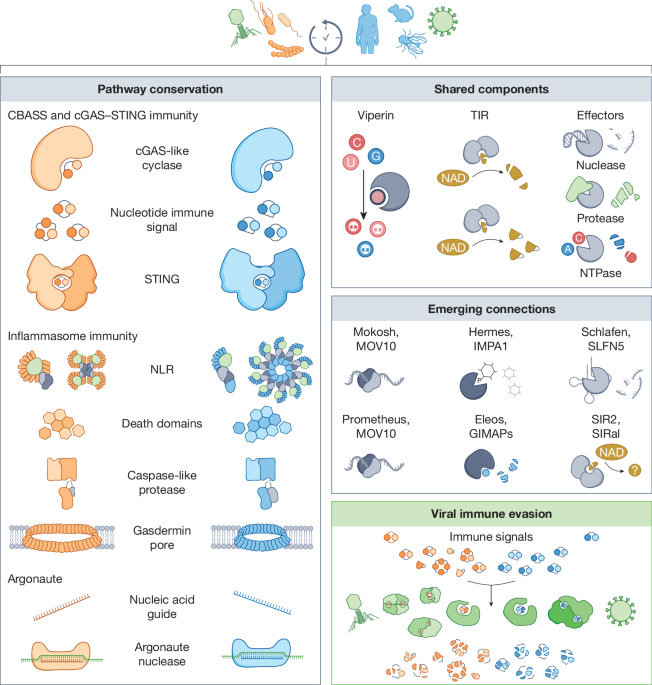
Defence against viral infection is a conserved feature of all cellular life. From single-cell bacteria to humans and complex multicellular animals, constitutive and inducible forms of immunity are required to inhibit viruses and safeguard cellular fitness. Recent studies reveal that the components of human antiviral immunity are surprisingly ancient, originating billions of years ago in bacteria as pathways that defend against phage replication. The unification of previously disparate fields of human and bacterial immunity creates a foundation to explain key features of host–virus interactions. This Review defines principles of pathogen recognition, signal amplification and immune effector function that shape mechanisms of antiviral immunity that are shared across kingdoms of life. Shared forms of immunity, including cGAS–STING, inflammasomes, argonautes and viperin, reveal ancient features of antiviral defence. Similarly, direct comparisons of pattern recognition receptors and interferon-stimulated genes in human cells with CRISPR immunity and anti-phage defence systems in bacteria explain prevalent strategies to effectively sense and inhibit viral replication. Cross-kingdom analysis reveals universal rules that control host–virus interactions and highlights open questions in understanding of antiviral immunity.
This is a preview of subscription content, access via your institution
Access Nature and 54 other Nature Portfolio journals
Get Nature+, our best-value online-access subscription
Prices may be subject to local taxes which are calculated during checkout
Iuliano, A. D. et al. Estimates of global seasonal influenza-associated respiratory mortality: a modelling study. Lancet 391, 1285–1300 (2018).
Article
PubMed
Google Scholar
Mazur, N. I., Caballero, M. T. & Nunes, M. C. Severe respiratory syncytial virus infection in children: burden, management, and emerging therapies. Lancet 404, 1143–1156 (2024).
Article
CAS
PubMed
Google Scholar