// NATURE NEWS — SPAZIO & SCIENZA
Towards an equitable future of global photovoltaic waste recycling
Nature
(2026) Cite this article
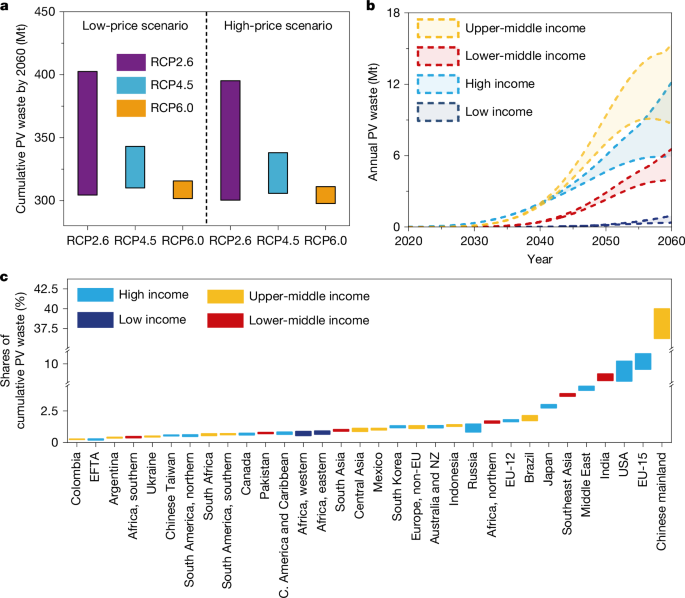
The world is confronting an escalating crisis of burgeoning photovoltaic (PV) waste1. However, the effectiveness and scalability of prevailing PV waste management approaches remain unclear owing to considerable heterogeneity across regions and over time. Here we develop a comprehensive framework to evaluate the economic and climate benefits of local versus outsourced recycling, covering mainstream technologies. Considering supply-side material constraints, global PV waste will reach 297–402 million tonnes by 2060, with middle-income regions such as China becoming major contributors after 2040. Notwithstanding anticipated technological advancements, the break-even point for global PV waste recycling remains more than a decade away. Combining region-specific recycling technologies with outsourced recycling strategies yields the maximal global net benefits, reducing greenhouse gas emissions by up to 3.32 billion tonnes of CO2-equivalent and generating cumulative net benefits of US$529.1–935.5 billion by 2060. However, outsourced recycling raises inequality concerns for low-income regions. Our results show that a well-designed declining-subsidy scheme effectively mitigates these inequalities, particularly in the early stages. We suggest that regionally adapted recycling strategies and international cooperation, with a focus on technology transfer and funding for recycling capacity in low-income regions, provide effective ways to achieve equitable and scalable PV waste circularity.
Rapid deployment of PV systems accelerates decarbonization and expands energy access; however, the impending end-of-life (EOL) PV module waste crisis has become a global concern. By 2050, global PV waste is projected to reach 200 Mt (2 × 10⁸ t)2. Unregulated disposal of these modules presents acute environmental hazards, including the leaching of toxic heavy metals (such as lead and cadmium) into soils and groundwater systems3,4, a concern exacerbated by the untapped reservoir of valuable materials and strategic minerals (such as silicon, tellurium, silver and copper) contained within them5,6. Effectively recycling EOL PV modules is therefore not only an environmental imperative but also a strategic necessity to secure material supply chains for future PV deployment and sustain global decarbonization goals.
Given the critical role of PV recycling in critical metal supply security and environmental safety, the issue has garnered worldwide attention7,8. International bodies and major economies have implemented multifaceted policies and regulations to address this pressing issue. For example, the EU has mandated the collection and recycling rate of EOL PV modules through the Waste Electrical and Electronic Equipment (WEEE) Directive, and Victoria, Australia, has implemented a landfill ban for PV waste9,10. China, the world’s largest PV installer, recently launched a comprehensive policy portfolio aiming to advance recycling technologies, reduce costs and improve resource efficiency11. These policy incentives have spurred the development of mechanical, thermal and chemical recycling technologies, each with distinct trade-offs in cost, resource recovery and emissions12,13. Compounding these dynamics is the practice of exporting EOL PV modules for recycling, driven by inadequate local capacity across regions14,15. However, the effectiveness of current PV waste management strategies remains unclear, particularly amid substantial cross-national and regional heterogeneity in socioeconomic conditions, supply-chain structures, historical PV installations, policy frameworks and technological capabilities16. Furthermore, these contextual factors are expected to evolve substantially in the future. Understanding PV waste management performance across heterogeneous regions and under plausible future scenarios (for example, climate targets, material supply constraints, installation trajectories and policy sh