// NATURE NEWS — SPAZIO & SCIENZA
Evidence for the first globular cluster stellar stream beyond the Milky Way
Nature
(2026) Cite this article
The dark matter content of ultra-diffuse galaxies (UDGs) is the subject of considerable debate1,2,3,4,5. Stellar streams, which form when a host galaxy tidally strips stars from an orbiting stellar system, provide a powerful technique to constrain the dark matter content of external galaxies6. The stripped stars form long, thin leading and trailing tidal arms that persist for billions of years. Stellar streams from globular clusters (GCs) are particularly sensitive probes of dark matter halos and substructure7,8,9,10. GC streams are expected to exist in a variety of host galaxy types11,12 but, so far, they have only been observed in the Milky Way (MW). Here we present evidence for the first, to our knowledge, extragalactic GC stellar stream, identified in deep Hubble Space Telescope (HST) imaging of the UDG UGC 9050-Dw1. The stream’s morphology, colour and apparent association with a compact source support the GC progenitor interpretation observationally and we reproduce the observed surface brightness with simulated GC stellar populations. We use generative stream modelling, which fits dynamical models directly to the stream morphology, to constrain the mass of the progenitor and present the first stream-based halo constraint for an UDG. The stream models point to a GC origin and suggest a massive dark matter host halo. By extending the reach of GC stream analysis to external galaxies, this work opens a new chapter in dark matter science.
Recent capabilities to detect low-surface-brightness objects have led to the discovery of numerous UDGs13,14: galaxies with dwarf-like stellar masses but MW-like extents15. The methods available for inferring their detailed mass and density distribution remain limited, as their characteristic low surface brightness means that measuring velocity dispersions or rotation curves is challenging16.
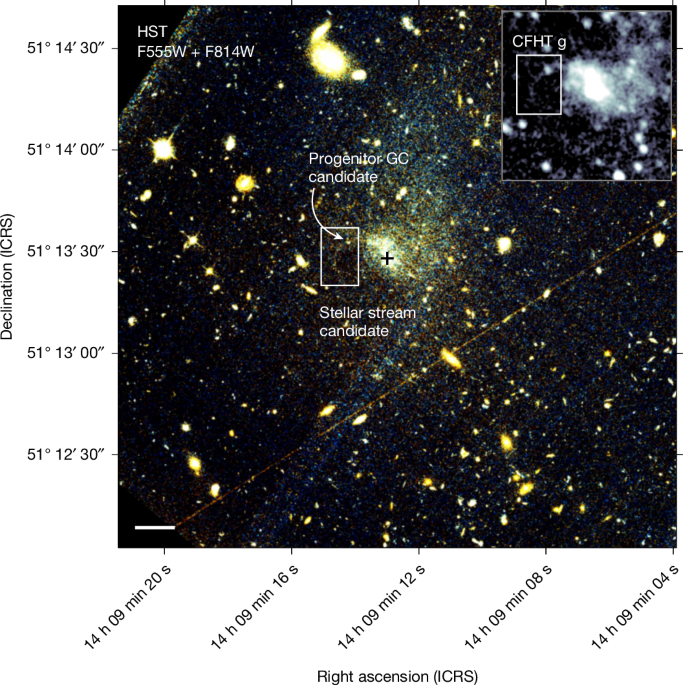
Figure 1 shows observations of the UDG UGC 9050-Dw1 by the HST and the Canada–France–Hawaii Telescope (CFHT), in which we highlight a feature resembling one arm of a stellar stream extending from a GC candidate. The thin stream candidate and its presumed parent GC have a projected distance of about 2.5 kpc to the centre of UGC 9050-Dw1, which is probably associated with the low-surface-brightness spiral galaxy UGC 9050 at a distance of 35.2 ± 2.5 Mpc (refs. 17,18). UGC 9050-Dw1 was first identified in CFHT images as part of a diffuse dwarf galaxy search19. The HST image was presented in a detailed analysis of UGC 9050-Dw1’s GC population, which found that most of the GCs probably formed simultaneously during a past dwarf merger event17. The stream-like feature, which we name Oyashio (after a cold Pacific ocean current, pronounced [], inspired by the nomenclature introduced in ref. 20), is identified independently in the HST and CFHT data, ruling out imaging or data processing artefacts as its origin. All available data are shown in Extended Data Fig. 1.
Composite image of HST ACS/WFC F555W and F814W observations of the ultra-diffuse host galaxy, UGC 9050-Dw1. The Oyashio stream and parent GC candidate are marked with a box and an arrow, respectively. The black ‘+’ marks the luminosity centre of the host galaxy as estimated in ref. 17 and the scale bar illustrates 2 kpc at a distance of 35.2 Mpc. Inset, CFHT MegaCam g-band image zoomed to the vicinity of the feature. ICRS, International Celestial Reference System.
A comparison between the background-subtracted image counts, f, of the stream candidate and the standard deviation of the background, σ, gives a signal prominence of \(({f}_{{\rm{stream}}}-\,{\overline{f}}_{{\rm{background}}})/{\sigma }_{{\rm{background}}}=7.34\) in the combined HST image. We measure the width of the stream candidate to be w±σ = 72.3 ± 8.9 pc, assuming a Gaussian profile (see Methods and Extended Data Fig. 2). The amplitude, A, of this fit gives a signal-to-noise ratio of \(A/\sqrt{{\sigma }_{A}}=5.2\) for the HS