// SPACE.COM — SPAZIO & SCIENZA
Is empty space really empty? This magnetic star may finally solve a 90-year-old mystery
"We're not just studying astronomical objects anymore; we're using them to test the laws of nature."
When you purchase through links on our site, we may earn an affiliate commission. Here’s how it works.
That is the takeaway of a new study examining signals from a dead star, offering what researchers say is the strongest evidence yet that extreme magnetic fields can alter the properties of a vacuum, causing seemingly empty space to act like a prism and changing how light travels through it
The findings, led by Rachael Stewart, a graduate student in physics at the George Washington University, confirm a prediction of a strange effect first proposed 90 years ago.
"The information we obtained from looking at this distant star core also gives us clues about the nature of the fabric of reality as we know it, and I find that to be incredible," Stewart said in a statement.
The idea dates to 1936, when the German physicist Werner Heisenberg and his student Hans Euler proposed that space is never truly void. Instead, they argued, it is a simmering sea of "virtual particles" — electrons and their antimatter counterparts, positrons — that flicker in and out of existence, briefly interacting with their surroundings before vanishing.
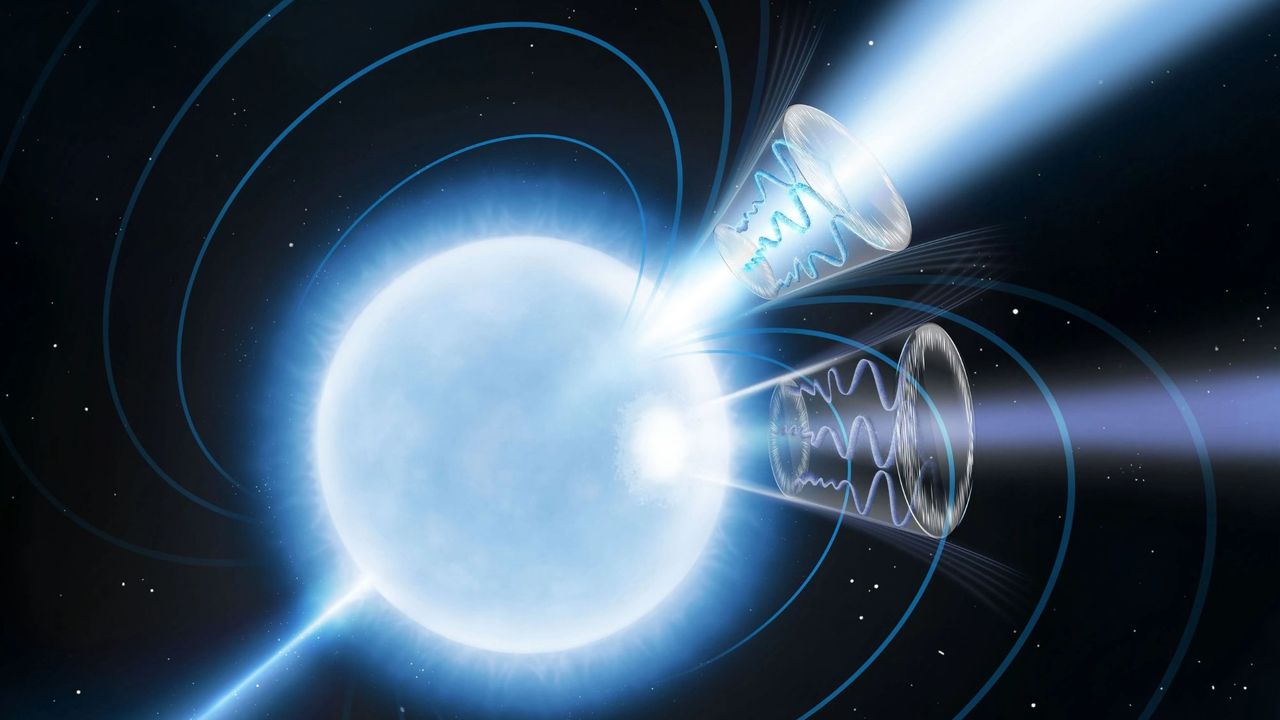
This subatomic froth is a consequence of quantum mechanics, and it remains invisible under ordinary conditions. But the theory predicts that an extremely strong magnetic field, such as one around a magnetar, can change how light moves, causing the light's waves to become more strongly aligned in a particular direction in an effect known as "vacuum birefringence."
"Detecting vacuum birefringence requires a magnetic field that is over 100 million times stronger than any we've ever made on Earth," study co-author Marcus Lower, an astrophysicist at the Swinburne University in Australia, said in another statement. "Thankfully, nature has provided us with magnetars, which are the perfect cosmic laboratories to go looking for this effect."
Magnetars are dense, city-size remnants left behind after massive stars explode, hosting the most powerful magnetic fields known in the universe. They are among the rare celestial objects capable of generating fields strong enough to reveal vacuum birefringence, offering scientists an extreme environment to test physics under conditions impossible to replicate on Earth.
"We're not just studying astronomical objects anymore; we're using them to test the laws of nature," study co-author Michela Negro, an astrophysicist at the Louisiana State University, said in a statement.