// NATURE NEWS — SPAZIO & SCIENZA
How the story of life and our planet unfolded — together
Dianne K. Newman is a professor of biology and geobiology at the California Institute of Technology in Pasadena.
Search author on:
PubMed
Google Scholar
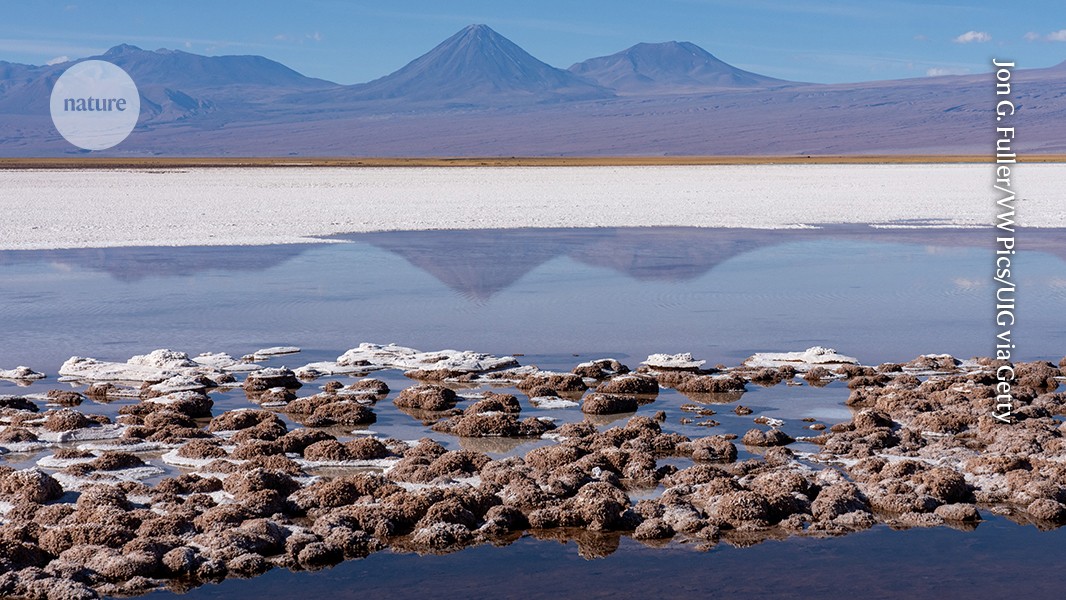
Fossilized microbial mats known as stromalites provide important records of some of Earth’s earliest life.Credit: Jon G. Fuller/VW Pics/UIG via Getty
Earth & Life: A Four Billion Year Conversation Andrew H. Knoll Princeton Univ. Press (2026)
On 14 February 1990, NASA’s Voyager 1 spacecraft turned around briefly to snap a picture of Earth before heading to the fringes of the Solar System. The image it captured — known as the pale blue dot — instantly became a classic.
Carl Sagan, the astronomer who suggested taking the picture, noted in his 1994 book Pale Blue Dot how, from afar, “our planet is a lonely speck in the great enveloping cosmic dark”. Everything we know is on that lump of gas-cloaked rock: “Our posturings, our imagined self-importance, the delusion that we have some privileged position in the Universe, are challenged by this point of pale light.” His subsequent writings about life on Earth were infused with awe and appreciation as well as sober existential reflection.
‘Climate free fall’: why the biggest risk to our economies is yet to be recognized
Over the centuries, many other scientists have wondered how life emerged on our planet. How did it take root? What enabled it to flourish? Does life exist elsewhere in the Universe? Is it common? Will we ever be able to know with certainty?
Such questions motivate Andrew Knoll’s book Earth & Life. A labour of love by one of geobiology’s most respected scholars, it builds on his earlier work, Life on a Young Planet (2003). This latest book, written for a general audience, emphasizes how physical, chemical and biological processes have engaged with each other and evolved together over time — in short, they have struck up a conversation.
Knoll introduces the reader to the field of geobiology, a melting pot of disciplines, through his personal and professional experiences. He relates how he discovered, as an undergraduate student, that life and Earth have influenced each other’s development — a profound intellectual awakening. He then sketches geobiology’s history, paying homage to the field’s key contributors over the past three centuries, from the Age of Enlightenment to the present.