// TOM'S HARDWARE US — HARDWARE & GADGET
AI data center optical interconnect market to hit $144 billion by 2030, an over ten-fold increase from 2024 figures, according to new projections — silicon photonics expected to account for nearly two-thirds of revenue, driven by co-packaged optics
Demand for 400 Gbps chips is expected to flatline as 1.6Tbps becomes the norm.
When you purchase through links on our site, we may earn an affiliate commission. Here’s how it works.
The global data center optical interconnect market is expected to reach $144.4 billion by 2030, up from $13.7 billion in 2024 — a 48.1% compound annual growth rate (CAGR) — according to a China Insights Consultancy (CIC) report commissioned by a Chinese laser-chip maker, Yuanjie Semiconductors, as part of its Hong Kong IPO filing. The report draws on data from LightCounting and interviews with industry experts. Of that future market, silicon photonics, the practice of manufacturing photonic chips from the same silicon material and mature CMOS foundry processes used for conventional semiconductors, is projected to account for 63.7% of revenue, its share climbing from 16.6% in 2020 as the industry shifts toward denser, more power-efficient designs like co-packaged optics.
The moves that would turn those projections into reality are already well underway. Over the past year, the AI industry has invested more than $15 billion in co-packaged optics, photonic chips, higher-speed transceiver modules, and fiber, developing new integration techniques, acquiring photonics startups, and forming alliances among the biggest players. More recently, OpenLight and Tower Semiconductor placed OpenLight's photonic design kit inside Cadence's mainstream chip-design software. This step makes the laser-integrated 400G and 1.6T chips at the heart of co-packaged optics easier to design and bring to market.
For decades, data centers have relied largely on copper traces and cables to move data across circuit boards, within racks, and across clusters. Copper is cheap, reliable, and easy to integrate. However, its power consumption and signal losses increase sharply with bandwidth and distance. As AI data centers are packed with ever more powerful GPUs, shuttling enormous volumes of data and pushing networks toward higher speeds, copper hit a wall. Past a few hundred gigabits per lane, its usable reach collapses to a meter, or two, before signal loss and power draw become unmanageable.
The solution has been a transition to photonics, moving data as light instead of electrical signals. An optical transceiver converts electrical signals from switches and processors into laser light, sends it down a fiber, and converts it back at the far end, carrying far more bandwidth over greater distances at much higher speeds. Today, pluggable transceivers pack a laser chip, digital signal processor (DSP) chips, and several optical components into one compact module. As GPUs grow more capable and AI workloads swell, both the volume of data and the speed it must travel keep climbing, pushing the industry from 400G links to 800G to 1.6T and beyond
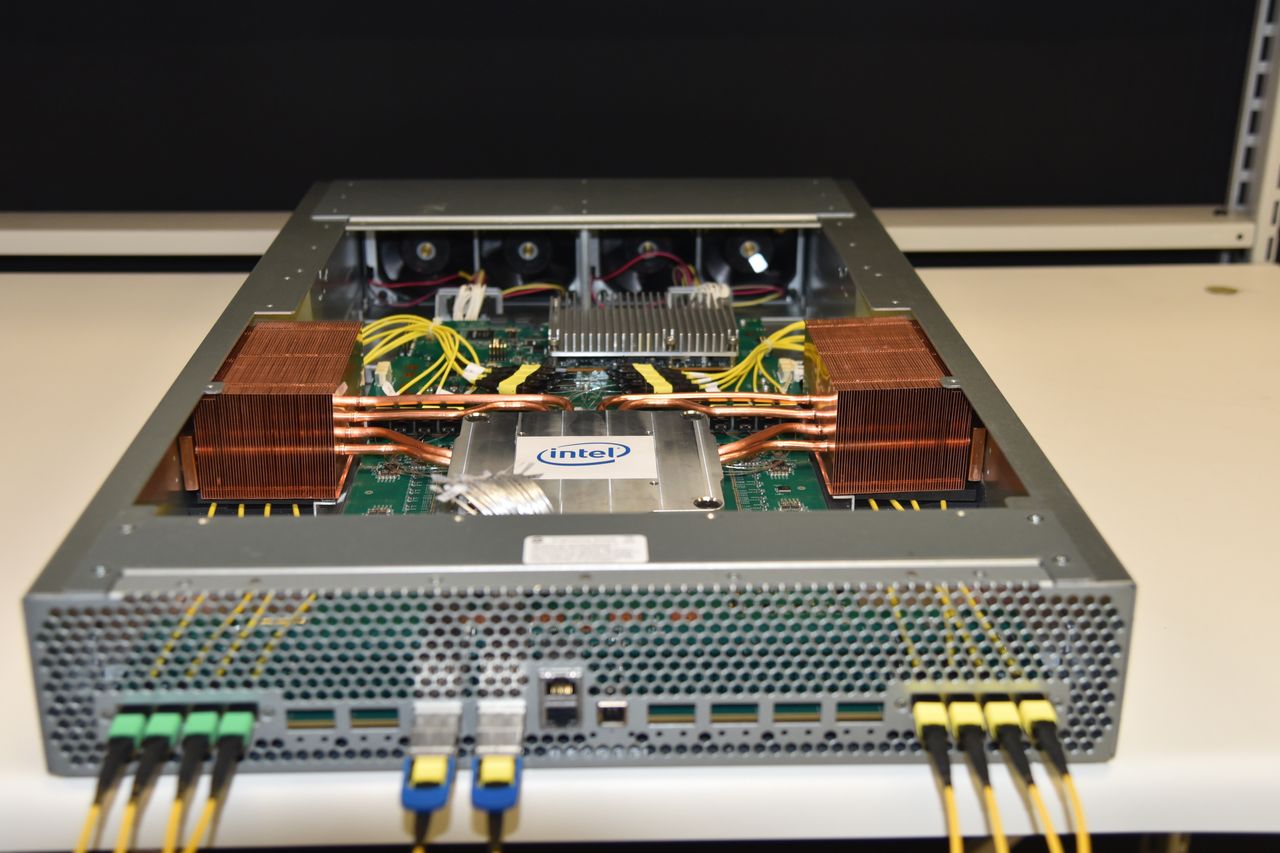
At the same time, the industry is trying to move the optics closer to the compute. In conventional systems, GPU signals travel inches along copper traces across the board to reach the transceiver on the faceplate. At extreme data rates, even that relatively short electrical journey consumes considerable power. Co-packaged optics (CPO) fixes this by pulling the optical engine out of the pluggable module and placing it as a chip — the photonic integrated circuit (PIC) — directly on the switch or accelerator package, shrinking the electrical path to millimeters. The push for faster optical chips, aiming for terabits-per-second speeds, serves both CPO and the pluggable modules that remain the industry mainstay.
The PIC does everything but generate light. Because laser chips are highly sensitive to heat, they can't be folded into the PIC, which, in co-packaged optics, becomes part of the switch or accelerator package that runs extremely hot. Therefore, the laser stays a separate chip. Whether feeding a co-packaged PIC or a pluggable module, those laser chips are always needed, which is exactly what Yuanjie, the company that commissioned the CIC fo