// ARS TECHNICA — HARDWARE & GADGET
X-rays add new twist to narwhal's spiral tusk
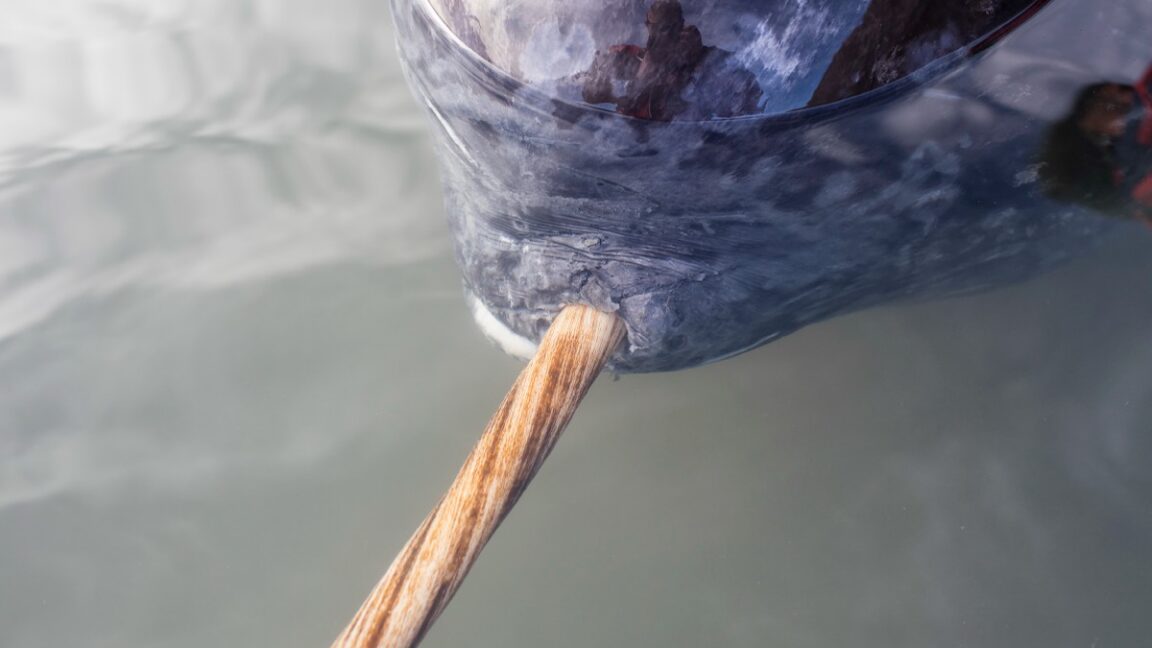
New study finds that the tusks have not one but two spirals, twisting in opposite directions.
Narwhals are toothed whales, renowned for their distinctive straight, spiraling tusks, which many people in medieval times believed were the horns of unicorns and thus held magical healing properties. That belief was debunked long ago, but the tusks remain popular souvenirs in Canada and Greenland. And they still hold a fascination for scientists keen to learn more about their unusual structure. A new paper published in the journal Nature Communications reports that rather than one left-oriented spiral, narwhal tusks also have a second internal spiral oriented in the opposite direction.
Inuit legend holds that a woman was dragged into the ocean by a harpoon rope after the weapon had hit a narwhal and was transformed into the animal herself. Her hair, which she’d worn in a twisted knot, became the spiral tusk. The tusk is actually a canine tooth in the left upper jaw of male narwhals, pushing through the lip when the males reach two or three years of age and growing to lengths as long as 1.5 to 2 meters (just under 5 feet to 9 feet 10 inches). Some males may develop two long spiral tusks or, in rare cases, none at all.
There’s a general consensus that these tusks most likely evolved via sexual selection as a form of social status. They clearly aren’t crucial for survival, since the females usually don’t develop the tusk—and if they do, the tusks are much smaller with fewer spirals—and yet typically live longer than the males. But the precise function of the tusk is still a matter of considerable debate.
Narwhals have been observed using them to stun small Arctic cod while hunting. It’s possible they are used as weapons in fights, but this behavior hasn’t been directly observed, although there have been narwhals found with tusks embedded in their bodies. The presence of several million nerve endings suggests that narwhals may be able to sense temperature or salinity changes in the water with their tusks.
Scientists know that the tusk consistently twists in the left-handed direction and that it is composed of dentine covered by a thin layer of cementum encasing a central pulp chamber. The dentine and cementum, in turn, are made up of microscopic collagen fibrils mineralized with nanoparticles of hydroxyapatite. The macroscale spiral shape emerges somehow from how those fibrils organize themselves. That structure also determines the tusk’s material properties. One question is whether the helical structure is also present at the micro- and nanoscale.
But nobody had mapped the interior structure in three dimensions at the atomic, nano, and macroscales. So the authors of this latest paper studied two male narwhal tusk and skull specimens by combining multiple imaging techniques: X-ray computed tomography, scanning X-ray diffraction, scanning small-angle X-ray scattering and tensor tomography, and bifringence microscopy. That required reserving time on three large synchrotrons in Sweden, Switzerland, and France. They also performed standard morphological measurements and conducted mechanical three-point bending tests.
The results showed that the collagen fibrils and hydroxyapatite nanoparticles orient themselves along the tusk’s longitudinal axis, so there is a consistently high degree of anisotropy at all scales. But there are tiny systemic deviations at small angles in that orientation, which in turn create the twisted structure. While the cementum layer forms the known left-handed helix, the dentine forms a right-handed helix.
That double-helix structure is the secret to the tusk’s remarkable stiffness and strength, with the flexible fibers and stiff mineral matrix enabling the tusk to withstand strong forces, like bending and twisting without cracking. It also allows the narwhal tusk to grow straight, unlike, say, an elephant’s curved tusk. The team also noted a finer underlying microstructure in the cementum of collagen fiber bun