// NATURE NEWS — SPAZIO & SCIENZA
South Africa’s scientists must register with official body or risk prison, according to draft law
Sarah Wild is a freelance journalist in Canterbury, UK.
Search author on:
PubMed
Google Scholar
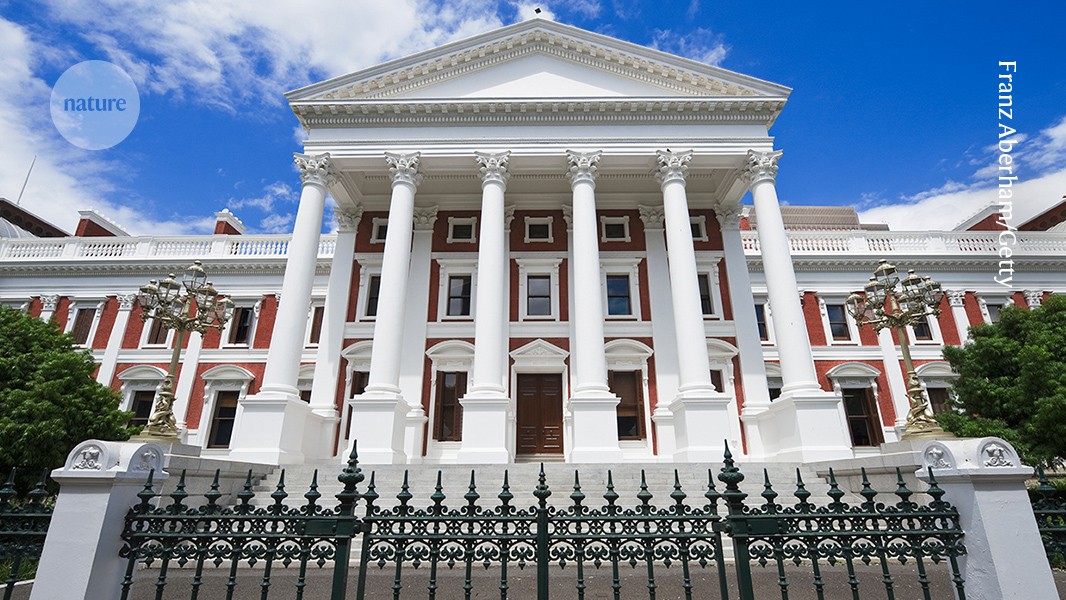
The South African parliament has yet to debate the proposed natural-sciences bill. Credit: Franz Aberham/Getty
Natural scientists in South Africa could be imprisoned for up to a year for failing to register with a government-backed regulatory body, according to proposed legislation that is to go before South Africa’s parliament.
Under the terms of the proposed law, it will be mandatory for some scientists to register with an existing body called the South African Council for Natural Scientific Professions (SACNASP). SACNSP was set up in 2003 and all natural scientists in the country were meant to have registered with it, but many never did.
“Our goal is not to be gatekeepers, but to professionalize the natural sciences through registration and regulation,” SACNASP’s acting chief executive Matshidiso Matabane told Nature. “It is our obligation to not only protect the profession itself, but the public and the environment,” she added.
The proposed legislation states that it aims to “protect and promote the public interests by regulating the conduct of practising natural scientists” and “to ensure the protection of the environment”.
It would regard natural scientists similar to engineers and healthcare professionals, who need to register with their respective regulatory bodies: the Engineering Council of South Africa and the Healthcare Professions Council of South Africa.
However, leading scientists have told Nature that many researchers are unaware of the law, or of the possible penalty of a jail term. A date for the legislation to be debated in parliament has yet to be set.
“It’s a money-making scheme,” says Nithaya Chetty, a physicist and dean of science at the University of the Witwatersrand, Johannesburg, who is not registered with SACNASP and was unaware of the proposed law until Nature brought it to his attention. He says he is concerned that the draft bill “gives the SACNASP board considerable future power”, and adds that it is ambiguous in its definitions.