// NATURE NEWS — SPAZIO & SCIENZA
Observation of conformal field theory spectra in a quantum simulator
Nature
(2026) Cite this article
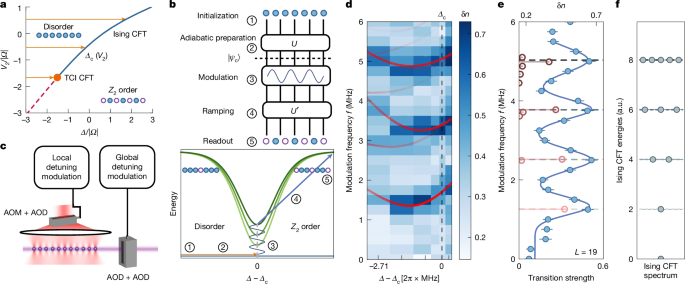
Conformal field theories (CFTs) feature prominently in high-energy physics1,2, statistical mechanics3 and condensed matter4,5,6. For example, CFTs govern emergent universal properties of systems tuned to quantum phase transitions4,7, including their entanglement, correlations and low-energy excitation spectra. Much of the rich structure predicted by CFTs nevertheless remains unobserved in experiment. Here we directly observe the energy excitation spectra of emergent CFTs at quantum phase transitions—recovering universal energy ratios characteristic of the underlying field theories8,9. Specifically, we develop and implement a modulation technique to resolve the finite-size spectra of a Rydberg chain, variably tuned to quantum phase transitions described by either Ising or tricritical Ising CFTs. We also use local control to distinguish parities of excitations under reflection and, in the tricritical Ising chain, to induce transitions between distinct CFT spectra associated with changing boundary conditions. By using a variant of the modulation technique, we furthermore study the dynamical structure factor of the critical system, which is closely related to the correlation of an underlying Ising conformal field. Our work not only probes the emergence of CFT features in a quantum simulator but also provides a technique for diagnosing a priori unknown universality classes in future experiments.
Conformal field theories (CFTs) are quantum field theories preserving conformal transformations that tightly constrain physical observables. Although conformal symmetry generally does not manifest microscopically, it can emerge over appropriate length scales. In the high-energy context, the correspondence between anti-de Sitter (AdS) space and CFT posits a duality between a CFT and quantum gravity in AdS space1. In many-body systems, CFTs commonly describe universal phenomena at quantum phase transitions (QPTs)—zero-temperature critical points separating distinct phases of matter, at which conformal symmetry emerges at long distances and low energies4.
A CFT is specified by data that determine universal features such as quantum entanglement structure and critical exponents governing space–time correlations. These features manifest in finite-size scaling, a powerful diagnostic in systems governed by two-dimensional CFTs: Cardy showed in the 1980s (ref. 8) that the pattern of low-energy levels in a finite system directly reveals the CFT operator content—which fields are present and their scaling dimensions. Moreover, toggling boundary conditions acts as a control knob that filters the allowed operators, and hence alters the observable low-energy spectrum.
In quantum materials, platforms for probing CFTs include magnetic insulators and quantum Hall systems by inelastic neutron scattering10,11,12,13,14,15,16 and electrical and thermal transport17,18,19,20 that can reveal select CFT properties. Recent advances in programmable analog and digital quantum simulators21,22,23,24,25,26,27,28,29 have enabled probing QPTs with complementary manipulation and readout techniques that offer a pathway to refined experimental characterization of CFTs. In this context, experiments showed power-law correlations while accounting for open-system effects suppressing long-range signatures of critical ground states30. Furthermore, dynamical properties—for example, Kibble–Zurek scaling and late-time quantum coarsening—were probed when ramping through QPTs31,32,33,34. However, a direct measurement of the rich excitation spectra of CFTs remains outstanding, in either solid-state systems or quantum simulators, despite its fundamental relevance.
Here we use a programmable neutral atom quantum simulator to measure the finite-size many-body excitation spectrum at one-dimensional QPTs, which are governed by two-dimensional (1 + 1D space–time) Ising and tricritical Ising (TCI) CFTs. To this end, we develop a m