// NATURE NEWS — SPAZIO & SCIENZA
Psychedelics align brain activity with context
Nature
(2026) Cite this article
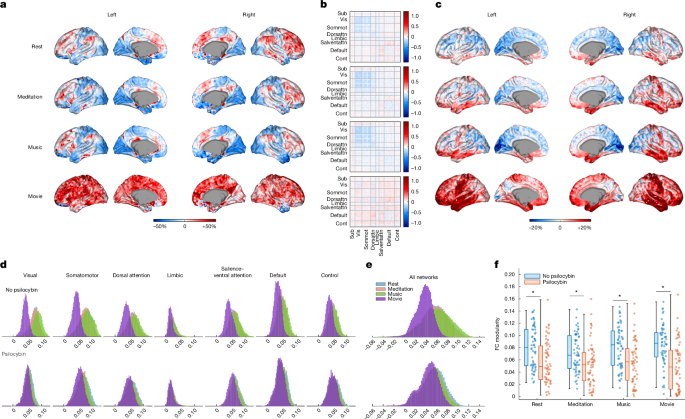
Psychedelics can profoundly alter consciousness by reorganizing brain connectivity1,2, producing acute experiences that shape lasting psychological change3,4. Psychedelic dynamics are commonly described as desynchronized or entropically disordered5,6, yet the brain organization underlying self-dissolving and boundary-dissolving experiences that participants often report7, and how context shapes that organization8, remain unresolved. To address this, we acquired the largest single-site psychedelic neuroimaging dataset to date. Sixty-two adults underwent functional magnetic resonance imaging (fMRI) and electroencephalography (EEG) during rest and naturalistic stimuli (meditation, music and movie), before and on the day of psilocybin administration (fMRI ~ 80 min post-dose; EEG ~ 150 min post-dose). Half ranked the experience among the most meaningful of their lives7. Here, using machine learning to represent the brain dynamics of each individual as low-dimensional trajectories, we show that psilocybin reorganizes brain activity into structured, context-sensitive patterns that co-vary with the quality of subjective experience, revealing a latent order missed by time-averaged measures. Networks that ordinarily segregate internal and external processing integrated, producing cohesive context-aligned trajectories in participants reporting the felt experience of being continuous with, rather than separate from, the environment, a state we refer to as embeddedness. The strength of this context alignment scaled with both the depth of self-dissolving and boundary-dissolving experience and the next-day mindset change. Our findings recast apparent disorder as latent organization aligned with context, linking neurobiology to subjective experience and behavioural change.
The profound effects of psychedelics reshape subjective responses to internal and external sensations and are frequently reported as among the most meaningful experiences in life7. These states can manifest sustained therapeutic benefits, including reductions in depression, anxiety and addiction, alongside an increase in social connectedness and overall well-being3,4,9,10,11,12,13,14.
The brain constructs perception and selfhood by integrating external sensory inputs with internal models of the environment15. These interactions between sensory and associative brain regions are enabled by structural and functional connectivity16. Psychedelics such as psilocybin disrupt these interactions by acting at the serotonin 5-HT2A receptor, inducing structural and functional plasticity in preclinical models—rapid medial prefrontal cortex spinogenesis persisting for weeks, mechanistically linked to enduring behavioural effects17,18—that can reshape macro-level connectivity19,20,21,22. Studies that examine effective connectivity further suggest that associative network communication becomes reconfigured23,24,25,26,27. Reflecting this reorganization, individuals frequently report an intensified sense of immersion, in which the context of space, time and selfhood feels deconstructed and interconnected28,29. Although the exact mechanisms linking brain network-level shifts to subjective experience remain unknown, these dynamics have typically been characterized as entropic and desynchronized5,6,30,31. A central mediator of these effects is the default mode network (DMN), which supports the integration of information from diverse associative regions spanning spatial, temporal and self-referential contexts32,33,34,35,36,37. Under psilocybin, connectivity patterns that constrain networks relax, permitting novel interactions between sensory and associative regions to emerge38,39. This reconfiguration alters connectivity patterns that underlie emotion, cognition and perception40. Of note, in healthy adults, psilocybin produces a persistent reduction in anterior hippocampus (aHip)–DMN connectivity, and in rodents, preclinical studies