// NATURE NEWS — SPAZIO & SCIENZA
Daily briefing: ‘Too hot to sleep’ is harmful to your health
Search author on:
PubMed
Google Scholar
Hello Nature readers, would you like to get this Briefing in your inbox free every day? Sign up here.
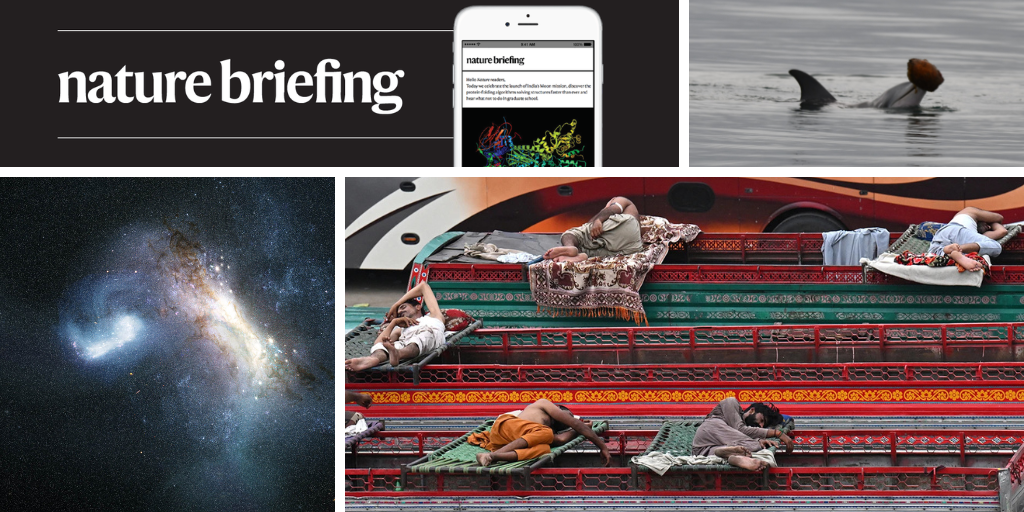
This calf is one of the first dolphins to be spotted shelling off the coast of Queensland, Australia. The behaviour had only previously been observed in a small number of dolphins in Shark Bay, Western Australia. (University of the Sunshine Coast Australia)
Researchers have recorded what appears to be an Indo-Pacific bottlenose dolphin (Tursiops aduncus) mother giving its calf a lesson in a hunting technique called shelling. The seldom-observed behaviour involves the dolphin catching a fish in an empty sea snail shell, lifting the shell out of the water and shaking it to drop the fish into its mouth. The team spotted an adult female surfacing with a shell containing a fish, and a calf lifting the same shell a few minutes later, which suggests that it was learning from watching its mother, they say.
Between 2010 and 2020, mortality rates for Black people were greater in US counties that relied heavily on slave labour in 1860 than those that had no slavery recorded at that time. Researchers also found that the more enslaved people there had been in a county, the greater the disparity between the modern mortality rates of Black and white people in those counties. Quantifying the link between slavery and modern health outcomes helps to reveal “the magnitude, the power, the strength of these historical events”, says social epidemiologist Zinzi Bailey.
Reference: Proceedings of the National Academy of Sciences paper
Astrophysicists have found evidence that the Milky Way collided and merged with a dwarf galaxy around 12 billion years ago. Using the Hubble Space Telescope, the team found that the makeup of some globular clusters — groups of stars held tightly together by gravity — doesn’t match that of those that are thought to be native to the Milky Way or that arrived during a later merger with another dwarf galaxy known as the Gaia–Sausage–Enceladus. “We do not know how our house was built,” says astrophysicist and study co-author Davide Massari. But these findings point to “where the first significant batch of bricks came from”.
Intense heatwaves are causing people to lose sleep, robbing them of a crucial aspect of health and recovery. But scientists don’t fully understand how hot nights affect health and sleep, write a group of environmental and medical researchers. “To get the full picture, measuring temperatures alone is insufficient,” they say. We need a better understanding of how meteorological measurements affect real-life bedroom conditions, the effects of long-lasting heat, the cumulative impacts of inequality — such as access to cooling — and a definition of what a good night looks like.
Institutions are increasingly overreacting to allegations of academic bullying, argues biomedical researcher Morteza Mahmoudi, who quit a faculty job in response to bullying and co-founded the Academic Parity Movement. “Complaints should be required to reference documented, specific patterns of behaviour measured against an established framework, not vague discomfort,” Mahmoudi argues. And those investigating bullying claims “should be trained in the science of workplace bullying”. Otherwise, conscientious mentors learn to fear doling out the constructive criticism that is key to good supervision, he writes.
Physician-scientist Carleton Gajdusek won a 1976 Nobel Prize for work on the brain disease kuru in Papua New Guinea. Even after his 1997 conviction for child sexual abuse, Gajdusek was lauded by several leading scientists. Gajdusek brought more than 30 children from various Pacific islands to live with him in the United States, and today some of them still grapple to make sense of their experiences. “America and the world can brag about the kuru studies and the many, many prizes, but what was the outcome of th