// NATURE NEWS — SPAZIO & SCIENZA
Exclusive: NSF set to issue lowest number of new grants in four decades
Search author on:
PubMed
Google Scholar
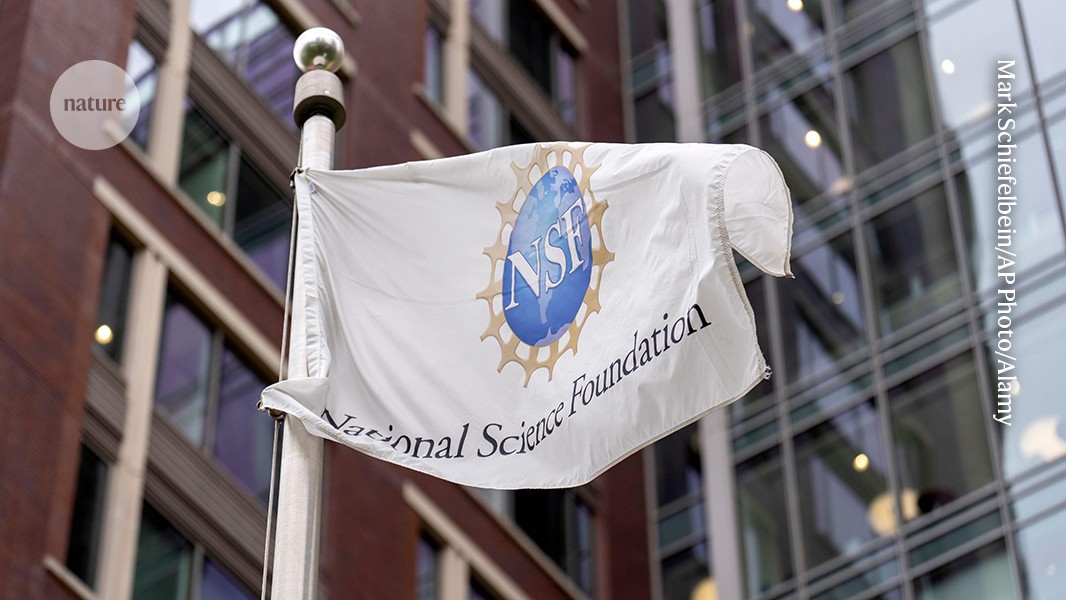
The US National Science Foundation has been a major funder of basic science in the United States. Credit: Mark Schiefelbein/AP Photo/Alamy
The US National Science Foundation (NSF) will award about 30% fewer new research grants this fiscal year than in the last one, Nature has learnt. The steep drop continues a pattern that began last year, after US President Donald Trump took office, leaving the NSF with the lowest number of new grants awarded in more than four decades.
White House rolls out AI funding — and signals a new era for US science
A major funder of basic science, the NSF struggled to make awards this year with a workforce that has been cut by the Trump administration and uncertainty around the funds available for spending. But the decline in new grants in 2026 can now be attributed mainly to US$1 billion of the agency’s $8.8-billion budget being held in a central account, inaccessible to core grant-issuing programmes. Staff members, who spoke to Nature on condition of anonymity out of fear of reprisal, say that much of that money is being allotted to a White House project called the Grand Research Challenges, which is aimed at scientific fields such as advanced materials and artificial intelligence.
The agency had issued 5,684 new grants as of 19 August, according to Grant Witness, a non-profit effort to track changes in US research funding. And internal NSF data show that there are around 400 grants waiting at its Office of Award Management (OAM) for processing. Staff members were required to submit all new proposals to the OAM by 3 August, so the final number of new grants issued for this fiscal year, which ends on 30 September, will almost certainly be about 6,100 (see ‘Grants throttled’). That’s 46% fewer than the average for 2021–24, before Trump took office. The last time this number was so low was in the early 1980s.
Many proposals that have been submitted by researchers and assessed by peer reviewers are in “pending purgatory”, says Jarett Wilcoxen, a chemist at the University of Wisconsin–Milwaukee. The proposals have not been declined, but they haven’t been fully approved and awarded money either. He submitted a grant proposal in late 2024 for an instrument that would be used by his laboratory and 20 others in the region. “It’s disappointing to see that the funds aren’t being allocated,” he says. “It’s a big impact on student training, and that student training is going to have a ripple effect from academia to industry.”
A spokesperson for the NSF said in a statement that the agency “is actively investing in foundational research across the sciences and engineering” consistent with priorities laid out by the Trump administration. It is also “focusing on longer awards with larger funding amounts” to lessen researchers’ administrative burden, among other goals, they said. The spokesperson did not directly respond to questions about the withheld funds.
The $1 billion in the central account can be spent next year, because the NSF has two years to spend funds assigned by the US Congress, which sets federal budgets. But withholding this much of the agency’s budget in one year is unprecedented, says Neal Lane, a physicist who directed the NSF from 1993 to 1998 under former president Bill Clinton. “I would never have imagined it happening under previous administrations.”
Early in the 2026 fiscal year, the NSF was slowed down in its grant-making by a 43-day US government shutdown. This forced the agency to reschedule hundreds of meetings at which panels of independent scientists gather to review grant proposals. Then the NSF waited until mid-April to release funds so that its programme officers could begin making awards.