// KOTAKU — GAMING
Metal Gear Solid 4: Guns Of The Patriots: The Kotaku Review
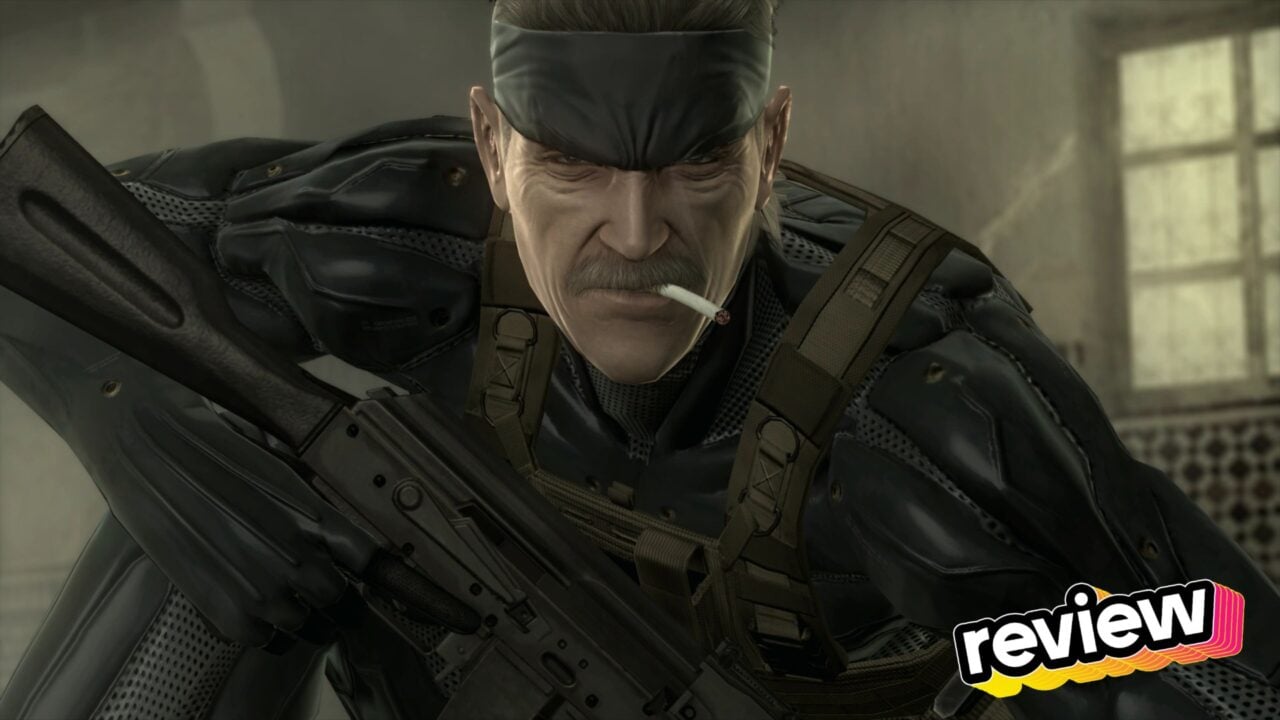
I’m admittedly a Johnny-come-lately to the work of Hideo Kojima. It took me until 2020 to play Metal Gear Solid and Metal Gear Solid 2 (finishing the latter less than 24 hours after Election Day—a confluence of events so thuddingly ironic that it could easily be a plot point from the game itself), and until 2024 to play Metal Gear Solid 3, via Master Collection Vol. 1. These are, indeed, some of the best games ever made: inquisitive, personal, needle-sharp things that probe the possibilities of interactive fiction in ways both generous and bombastic.
Until last week, I had not played Metal Gear Solid 4—not for lack of interest, but for lack of requisite hardware. Since its initial release in 2008, the game has been rotting behind bars in PS3 jail, a place that was assumed for years to be nigh-impregnable. Talk has long circulated about the obstacles preventing a modern rerelease, chief among them being the game’s heavy reliance on the PS3’s bespoke, convoluted processing architecture. Others have speculated that maybe its plethora of brand tie-ins—Apple, Playboy, Triumph Motorcycles, etc.—meant too much legal red tape. Many fell back on the more straightforward assumption that a port was doable, but Konami just couldn’t be arsed.
Whatever the reason, we need pine no more. Eighteen years and some internal shake-ups later, Metal Gear Solid 4 has finally been liberated, and the results speak for themselves. For those who have played the game before and are only looking for an impression of its technical performance and faithfulness to the original: Metal Gear Solid 4 on PS5 runs in 4K resolution at a buttery and consistent 60 frames per second. Most if not all of the copyrighted material is preserved. And yes, Otacon’s gag about not needing to swap discs on the PS3 has been cheekily adjusted. A great deal of care was clearly put into this project, and at the risk of hyperbole, finally having every mainline entry in the Metal Gear Solid series accessible on one generation of hardware strikes me as a pretty historic moment for video game preservation.
For those new to the game, welcome to the club. There is nothing like Metal Gear Solid 4. Thinking about it for more than five minutes at a time makes me feel like I’ve been staring at the sun too long. I’m immensely grateful to have experienced it, and I will probably never play it again.
The first rule of Hideo Kojima is that he’s better than people give him credit for and the second rule is that he’s worse.
More specifically: Kojima is a great game designer and an…inconsistent writer whose reach sometimes exceeds his grasp. I don’t really mind this, broadly speaking—it’s heartening to see an artist so earnestly invested in interrogating and reinterpreting the boundaries of his chosen medium, even when he stumbles. Video games are still young, and they need people who care.
Metal Gear Solid stands out as a series that is reflective of both the anatomy and evolution of games as a whole. From the jump, it has wrestled openly with questions of agency, casting protagonist Solid Snake in the dual roles of player subordinate and player avatar—simultaneously a soldier following your orders and you, following the game’s orders. Attention is often called to Snake’s unmatched martial and tactical prowess, even as the games are designed to make players feel defenseless and withdrawn. This seems to be Kojima’s archetypal conception of the Video Game Character, and, by extension, the Video Game Player: someone with a pliable will, prone to suggestion, paradoxically both invincible and brittle depending on the buttons being pressed.
Meanwhile, to state the obvious, the series’ storytelling methods have been enormously influential. Metal Gear Solid was far from the first game to have cutscenes (Kojima himself was already pushing this particular envelope a full decade earlier with Snatcher), but its outsized direction and editing set a new bar for what the medium could accomplish in three di