// SPACE.COM — SPAZIO & SCIENZA
This ball of stars named Terzan 5 may be one of the Milky Way's original building blocks
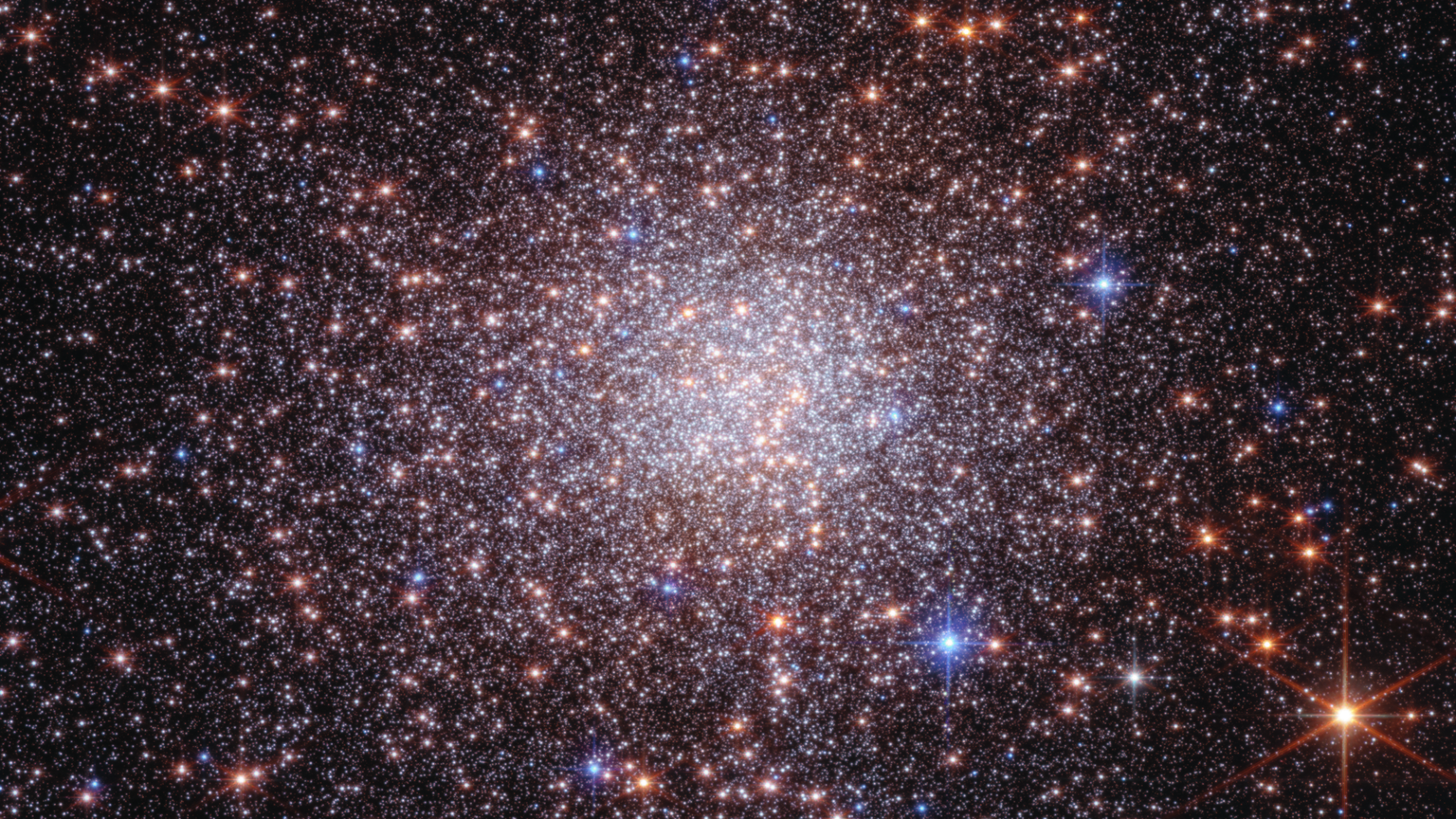
Four generations of stars have been identified in Terzan 5, as opposed to just one generation in most globular clusters.
When you purchase through links on our site, we may earn an affiliate commission. Here’s how it works.
A huge, shining bauble of stars called Terzan 5 could be a clump of our galaxy's central bulge that hasn't been smoothed out into the mix, and has instead survived as a fossil relic leftover from the birth of the Milky Way galaxy.
"Terzan 5 may provide direct evidence that can help explain how bulges formed in galaxies throughout the universe," said Barbara Lanzoni of the University of Bologna in a statement. Lanzoni is a member of a team of astronomers, led by Bologna colleagues Giorgia Zullo and Francesco Ferraro, who tackled Terzan 5 with the James Webb Space Telescope (JWST).
Terzan 5 is a globular cluster — a huge sphere of stars with a total mass two million times greater than our sun's and a total luminosity 800,000 times greater. The problem is, Terzan 5 lies about 18,800 light-years away in the bulge of the Milky Way galaxy. This means dense lanes of intervening galactic dust block our view, significantly dimming Terzan 5's apparent brightness. That's why it wasn't discovered until 1968 by the Turkish–French–Armenian astronomer Agop Terzan.
Globular clusters tend to be ancient. They also tend to have formed all their stars in one giant burst. As such, all their stars should be the same age, 12 to 13 billion years old. Yet, a select few globular clusters show evidence of having more than one generation of stars. These include Omega Centauri, NGC 2808 and NGC 1783 in the Milky Way galaxy, as well as NGC 411 in the Small Magellanic Cloud and NGC 1696 in the Large Magellanic Cloud. Several explanations have been put forward, including the possibility that they are the core remnants of dwarf galaxies that have been stripped of most of their stars by gravitational tidal forces emanating from the Milky Way. Or perhaps these clusters were simply massive enough to retain some molecular gas for future stellar generations.
When the Hubble Space Telescope took a look at Terzan 5 in 2009 and then again in 2016, it found that it too was among the ranks of weird globular clusters with two generations of stars, dating back 12.5 and 4.7 billion years. However, because it is behind so much galactic dust, not even Hubble has the clearest of views.
The JWST, however, does. Its near-infrared vision can see through the dust.
"Webb's new near-infrared observations, cross-referenced with Hubble's archival observations, have given us a much clearer picture of the history of Terzan 5," said study leader Giorgia Zullo, who is a Ph.D. student at Bologna.
The JWST detected two further generations of stars, one generation born 3.8 billion years ago and another 2.5 billion years ago. Four generations of stars is hard to explain for any globular cluster, which is why the team think that Terzan 5 could be something more primordial: a leftover building block of the Milky Way's bulge that was never quite assimilated by our galaxy.