// NATURE NEWS — SPAZIO & SCIENZA
Patient’s own mitochondria injected into eyes in attempt to restore vision
Search author on:
PubMed
Google Scholar
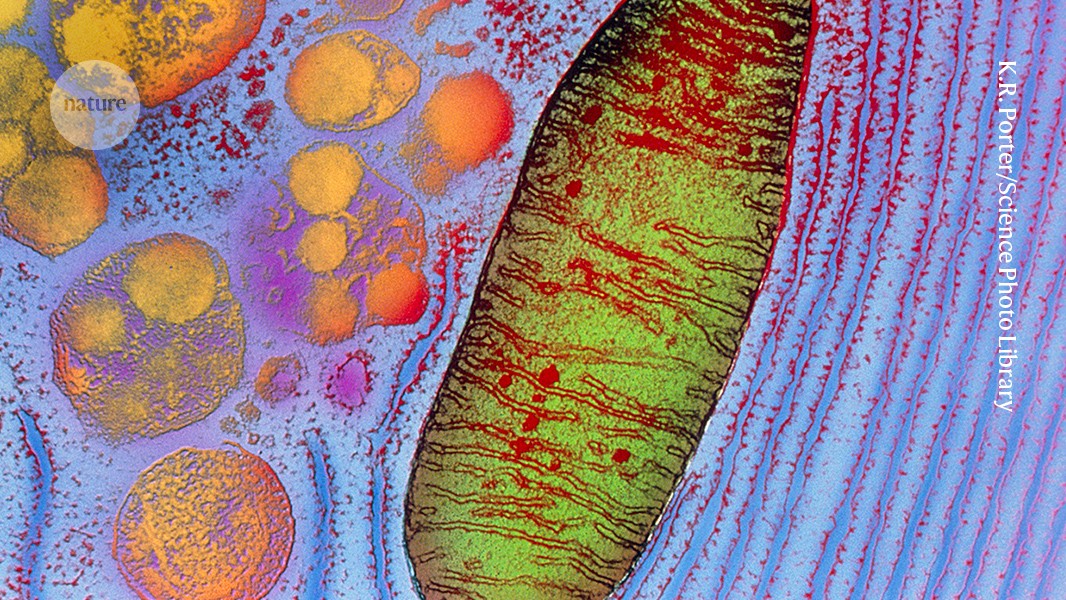
A microscope image of a mitochondrion, artificially coloured in green and red. The organelles were extracted for a retinal transplant from the person’s own leg muscles. Credit: K. R. Porter/SPL
Scientists have extracted mitochondria from a woman’s leg muscles and injected them into the vitreous fluid of her eyes in an attempt to treat severe blindness. The procedure caused no inflammation or side effects — but had a limited effect on restoring responses to light in the eyes, and did not restore the woman’s vision.
Transplanting healthy mitochondria — organelles that produce energy in cells — is being explored as a way to treat diseases that damage these organelles in tissues. The healthy mitochondria can be taken up by the damaged cells and, in some cases, boost cell survival and partially restore tissue functions. Previous trials in humans have transplanted mitochondria into the heart and brain. Now, scientists report the first such transplant in the eyes.
A brain bleed in February had injured the woman’s optic nerve and retina, causing nearly complete blindness, with no pupil responses to light flashed in her eyes. After the mitochondrial injections, her pupils showed a response to light, but the effect was temporary and subsided after about four weeks. The findings were reported in a preprint posted on 10 August, which has not been peer reviewed1.
The study shows that it was “relatively safe” to inject the person’s own mitochondria into the eyes, says Temurkhan Ayupov, a mitochondria biologist at the Institute of Molecular and Clinical Ophthalmology Basel, in Switzerland. But it does not confirm the therapeutic effect of a mitochondrial transplant, he adds.
The goal was to establish the safety of the approach, says David Putrino, a neuroscientist at the Icahn School of Medicine at Mount Sinai in New York City and a co-author of the preprint. “We can’t prove efficacy at all, nor are we trying to,” he adds, but “we saw a significant effect on physiological changes in the eye”.
Putrino and his colleagues wanted to explore whether injecting mitochondria directly into the eye could help to restore function in retinal ganglion cells — neurons in the inner surface of the retina that send vision signals to the brain.
Studies in mice have shown that delivering mitochondria into the vitreous fluid increased the survival of neurons that had remained viable after optic-nerve injury.
Cells are swapping their mitochondria. What does this mean for our health?