// NATURE NEWS — SPAZIO & SCIENZA
Insights into longevity and virus-driven adaptation from Myotis bat genomes
Nature
(2026) Cite this article
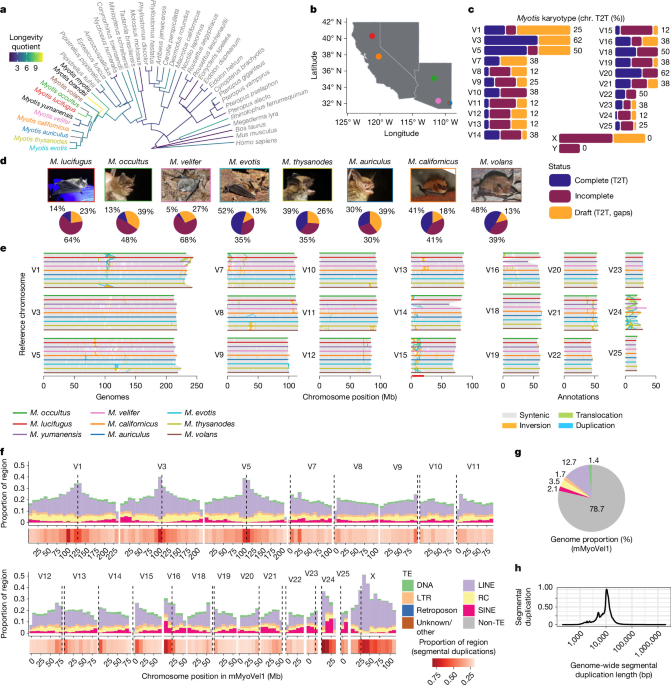
The genus Myotis is one of the largest clades of bats, and it exhibits some of the most extreme variation in lifespans among mammals, alongside unique adaptations to viral tolerance and immune defence1,2,3. Here, to study the evolution of these phenotypes, we generated cell lines and near-complete genome assemblies for eight closely related Myotis species. Using genome-wide screens of positive selection, analyses of structural variation and functional experiments in primary cells, we identify patterns of adaptation contributing to longevity, cancer resistance and viral interactions. We demonstrate distinct modes of adaptation to DNA and RNA viruses compared with all other mammals, with bats exhibiting genome-wide over-representation of positive selection for DNA-virus-interacting proteins and elevated rates of copy-number variation for RNA-virus-interacting proteins. Characterization of Myotis-specific duplications of the key immune factor EIF2AK2 (also known as PKR) reveals multiple ancient segregating trans-species copy-number polymorphisms. We show that the recurrent evolution of longevity seen in Myotis is associated with positive selection in cancer pathways, and demonstrate a unique response to DNA damage in primary cells of the long-lived Myotis lucifugus. Together, our results suggest that bats’ remarkable longevity and immunity are linked through pleiotropic adaptations to viruses and ageing-related disease.
Bats (order Chiroptera) represent approximately 20% of all known mammalian species and are one of the most phenotypically diverse clades of mammals4. Since their emergence 60 million years ago5, many bat lineages have independently evolved a wide variety of life history strategies and phenotypic traits, including exceptional longevity, viral tolerance and immune defences2,3. Systems in which shared traits have evolved de novo multiple times are powerful resources for dissecting the genetic basis of phenotypes. The largest genus of bats, Myotis, emerged approximately 33 million years ago6 and encompasses over 139 described species spanning 6 continents and a wide range of ecological niches7. Myotis species demonstrate some of the most extreme variation in lifespan among mammals1,8, including a sixfold difference in lifespan between the longest-lived species9 (Myotis brandtii, 42 years; Fig. 1a) and the shortest-lived species10 (Myotis nigricans, 7 years), which diverged approximately 10.6 million years ago11. Moreover, Myotis species are representative of bats’ notable immune mechanisms that enable viral tolerance and pathogen resistance12 contributing to their role as key zoonotic reservoirs2,13.
a, Phylogeny of Nearctic Myotis bats in this study, including outgroup species of bat, cow, mouse and human. Branches are coloured by their estimated longevity quotient, a ratio of observed-to-expected lifespan1. b, Map of capture sites in Arizona and California for samples generated in this study; each dot colour indicates the species. c, The completion status of each chromosome in assembly. The percentages next to the ideograms indicate the proportion of T2T-assembled chromosomes across species. d, The completion status of all chromosomes within each assembly, with representative images for the species shown above. For c and d, ‘complete (T2T) status’ indicates that a chromosome is fully assembled T2T without gaps; ‘draft (T2T, gaps)’ status indicates that a chromosome is fully scaffolded with both telomeres, but has one or more gaps in the assembly; ‘incomplete’ status indicates that a chromosome was positively identified, but was not scaffolded from telomere to telomere (contains only one telomere). e, Synteny between chromosomes of nine Myotis species showing syntenic regions (grey), inversions (orange), translocations (green) and duplications (blue). The red bar below chromosome V15 (x axis) indicates a locus of approximately 10 Mb where introgression w