// NATURE NEWS — SPAZIO & SCIENZA
Amphibious stem-insect sheds light on colonization of land
Nature
(2026) Cite this article
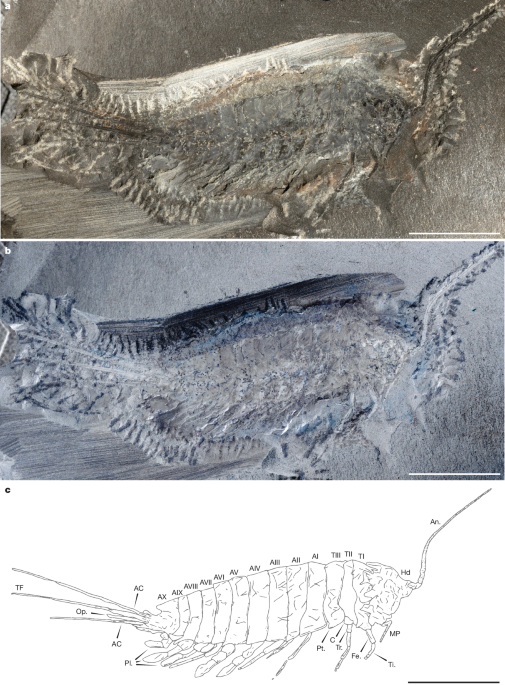
Molecular clock analyses1,2,3, trace fossils4, exceptionally preserved amphibious stem-myriapods5 and sea scorpions6 have recently challenged classical assumptions about the timeline of the animal colonization of land7, suggesting that terrestrial ecosystems may date back as far as the Cambrian period. However, the early evolutionary history of the most successful clade of animals, the insects, has remained elusive, as the period of their early diversification constrained by time divergence estimates falls within the notorious ‘hexapod gap’ in the fossil record8. Here we describe Chosha praecursor gen. et sp. nov. from the Carboniferous period (Late Mississippian epoch, approximately 324 million years ago) Tesnus Formation in Texas. Cross-polarized light imaging reveals that C. praecursor possesses insect apomorphies including an ovipositor and a terminal filament but differs from crown-group insects, most notably with respect to the presence of multisegmented abdominal legs with paddle-like modifications. Our phylogenetic reconstruction recovers C. praecursor as a hexapod, strongly favouring its placement as an early-diverging insect. A revision of three other enigmatic hexapod fossils, the Devonian period Leverhulmia and two undescribed Carboniferous fossils from the Mazon Creek Lagerstätte, demonstrates diverse body organization in Palaeozoic wingless insects. Together, these stem-group fossils represent the earliest uncontested insects and partly reconcile the incongruence between molecular clock estimates and the fossil record. The unusual abdominal gill-like appendages of Chosha suggest a semiaquatic mode of life in at least some stem-insects and revise our understanding of the assembly of insect morphological organization.
This is a preview of subscription content, access via your institution
Access Nature and 54 other Nature Portfolio journals
Get Nature+, our best-value online-access subscription
Prices may be subject to local taxes which are calculated during checkout
All data analysed in this paper, including the morphological character matrix and all full analysis files, are available at Zenodo (https://doi.org/10.5281/zenodo.19565988)75. Character descriptions and character matrix are also available in the Supplementary Information. The paper has been registered at ZooBank (LSID, urn:lsid:zoobank.org:pub:F392D634-11C0-423B-AD17-C847C6B9C8C7).
The datasets and the commands necessary to reproduce phylogenetic analyses are included as R and NEXUS formatted files available at Zenodo (https://doi.org/10.5281/zenodo.19565988)75.
Morris, J. L. et al. The timescale of early land plant evolution. Proc. Natl Acad. Sci. USA 115, E2274–E2283 (2018).
Article
CAS
PubMed
PubMed Central
Google Scholar