// SPACE.COM — SPAZIO & SCIENZA
The night we nearly saw a 'blood moon' (and why I love near-misses in astronomy)
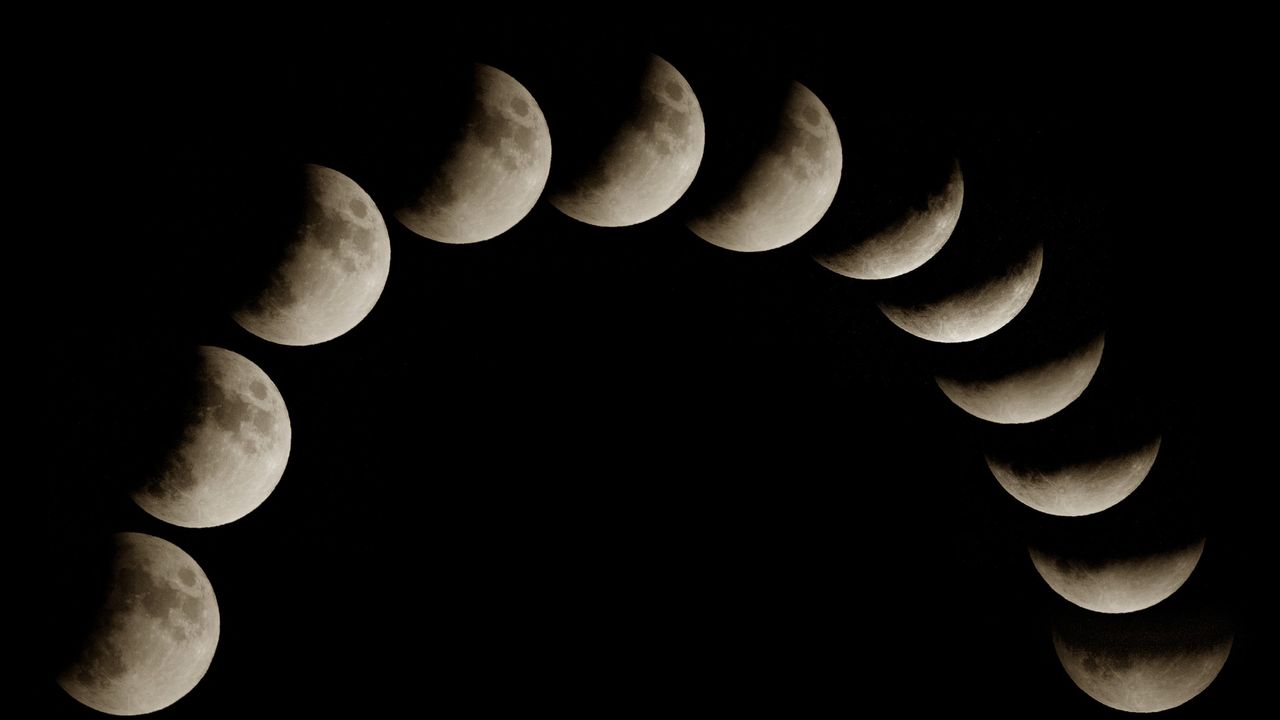
Astronomy is often about being close to extraordinary things without fully experiencing them. Here's why to love partials, grazings, faint objects and other almost-events.
When you purchase through links on our site, we may earn an affiliate commission. Here’s how it works.
Stargazers have trigger words — total, bright, peak, maximum, best. But observing the sky is often more interesting when something seems neither one thing nor the other.
A case in point was the almost-total partial lunar eclipse we just witnessed. From where I watched, early on Aug. 28, Earth's shadow reached its maximum across the lunar surface, covering 96.2% of it, as the moon began to sink in the west. A thin part of the lunar surface remained outside the darkest part of Earth's shadow, and the surface never did quite go red. At maximum eclipse, the moon looked like a sliver — totally unlike a crescent moon, and something very odd to behold — and came within a fingernail of becoming a totally eclipsed "blood moon."
Astronomy and stargazing are full of this sort of near-miss. A comet that nearly becomes bright enough to tell your neighbors about, but ultimately becomes nothing more than a smudge in binoculars that few can even find, let alone be impressed by. A meteor shower that's hyped as the strongest for years that doesn't live up to expectations. Or the worst kind — a cloud deck that clears a few minutes after a total solar eclipse comes to an end. We pretend these moments are failures because they do not match the headline version of the sky. But it's often the "almost" part that keeps the imagination alive.
A total lunar eclipse happens only when the entire moon passes into Earth's dark umbral shadow. On Aug. 27-28, the deep partial eclipse missed totality, but the bright uneclipsed sliver made the shadow easier to see and appreciate. Its almostness gave the event an unusual tension.
During a total lunar eclipse — also called a "blood moon," which gets headline writers very excited — the red color comes from sunlight filtering through Earth's atmosphere. Shorter blue wavelengths scatter more efficiently, while longer red and orange wavelengths are bent into the shadow and onto the moon. In other words, the totally eclipsed moon is lit by the combined glow of sunrise and sunset around the rim of Earth. That sounds like a poetic exaggeration, but it's just physics.
A partial lunar eclipse is equally just physics. With the headline act of totality not on the agenda, I watched Earth's curved shadow creep across the lunar surface, almost reach across the entire orb, then gradually retreat. You could see the geometry working. You could see the moon move through a circular shadow — our planet's shadow. A lunar eclipse always gives you time to think because it unfolds slowly, but this gave me a chance to focus on the one thing we all ignore when we obsess over the "blood moon" moment — the moon moving through Earth's giant shadow in space.
Near-misses in astronomy occur when things do not perfectly align as seen from Earth. A good example is a grazing occultation, in which the moon almost crosses a bright star or planet, but not quite. Instead of seeing it disappear and re-emerge, the planet or star winks as it's skimmed by the mountains on the rugged edge of the moon. Spectacular examples include July 10, 2018, when red giant star Aldebaran blinked along the lunar limb, as seen from North America, and Aug. 24, 2023, when Antares played hide-and-seek behind the moon. It's proof that the moon has no atmosphere, though it's location-specific because the moon's apparent position in the sky varies by about two degrees depending on where you are. There are some good occultations (which all have grazing zones) coming up:
However, my favorite type of celestial near-miss is a solar eclipse, which comes in so many shapes and sizes that it's tough not to start collecting observations of them once you've started. If you like big partial eclipses — when the