// NATURE NEWS — SPAZIO & SCIENZA
Late-life semaglutide treatment slows ageing and extends lifespan in female mice
Nature
(2026) Cite this article
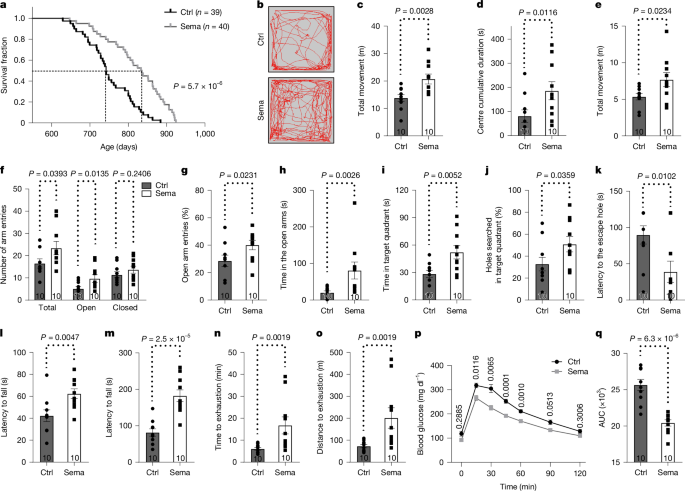
Pharmacological glucagon-like peptide-1 receptor (GLP-1R) activation reduces food intake and is an effective therapy for type 2 diabetes and obesity1. The use of GLP-1 medicines has revealed pleiotropic beneficial effects beyond glucose and weight control2,3,4,5, but little is known about the underlying basis of the pleiotropic effects. Here, treatment of 20-month-old female C57BL/6 mice with the GLP-1R agonist semaglutide for 3 months improved physiological function, attenuated hallmarks of ageing and modulated nutrient sensors and conserved genetic regulators of ageing. Continued treatment extended mouse lifespan. These effects parallel key features of calorie restriction, a dietary intervention that slows ageing, extends lifespan and alleviates a wide spectrum of ageing-associated diseases6. In a longitudinal study in direct comparison to matched calorie restriction, semaglutide treatment preserved baseline function and recapitulated many functional benefits of calorie restriction by attenuating age-associated decline, while also producing improvements above baseline and more favourable trajectories than calorie restriction in exploratory drive, spatial memory and glucose control. Together, these findings demonstrate that GLP-1R activation initiated late in life slows ageing and extends lifespan in female mice, supporting its function as a calorie restriction mimetic and providing a mechanistic framework that may help to explain its broad beneficial effects while revealing effects beyond those attributable to reduced calorie intake.
Calorie restriction, typically defined as reduced calorie intake without malnutrition, slows ageing and extends lifespan across species6. This dietary regimen also improves physiology and ameliorates a wide spectrum of seemingly unrelated diseases, such as metabolic diseases, neurodegenerative diseases, cancer and immune disorders6. Calorie restriction engages several evolutionarily conserved signalling pathways, such as sirtuins and insulin–IGF1 signalling, to elicit a beneficial response7,8,9. However, it is difficult to practice sustained calorie restriction. There is a need to identify calorie restriction mimetics that capture the health and longevity benefits and are suitable for human applications.
GLP-1 is secreted from gut endocrine cells in response to food ingestion, potentiates glucose-dependent insulin secretion and inhibits food intake10. Pharmacological GLP-1 receptor (GLP-1R) activation is an effective therapy for type 2 diabetes and obesity1. The use of GLP-1 medicines has revealed pleiotropic beneficial effects beyond glucose and weight control, such as reduction of heart, kidney and liver diseases, and neurodegeneration2,3,4,5. Little is known about the underlying basis of the pleiotropic effects. As GLP-1 administration inhibits food intake through brain GLP-1R activation11, we hypothesized that GLP-1 medicines might function as a mimetic of calorie restriction that slows ageing and alleviates various ageing-associated diseases. The effects of calorie restriction are influenced by individual characteristics, including factors such as age and health condition12,13,14. These considerations raise the question of how long-term use of GLP-1 medicines influences the ageing process and lifespan, particularly when treatment is initiated late in life.
We treated 20-month-old female C57BL/6 mice daily with either vehicle or semaglutide, a GLP-1R agonist, through subcutaneous injection. For lifespan study, treatment continued for the duration of the lifespan. For physiological, molecular and cellular studies, a separate cohort was treated for 3 months. Semaglutide treatment reduced food intake by 24% (Extended Data Fig. 1a,b), but did not significantly alter locomotor activity (Extended Data Fig. 1c,d), respiratory exchange ratio (Extended Data Fig. 1e,f; an indicator of fuel utilization), oxygen consumption (Extended Data