// NATURE NEWS — SPAZIO & SCIENZA
The nutritional value of invertebrate aquatic foods
Nature
(2026) Cite this article
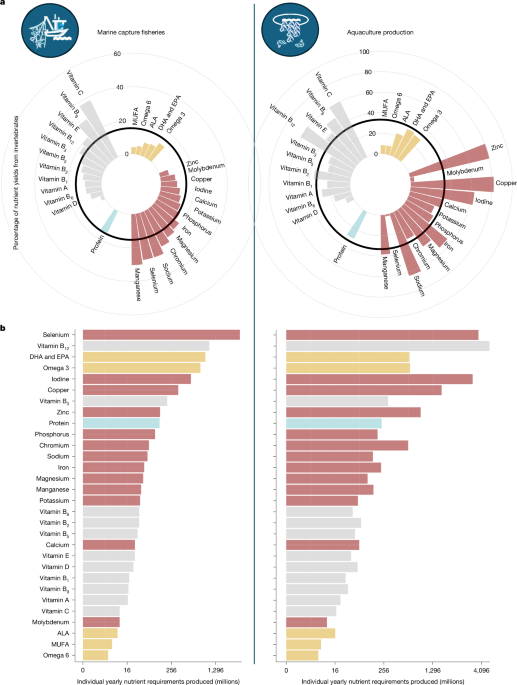
Most of the global population has inadequate micronutrient intake1, leading to cascading adverse effects on economies and human health2. Aquatic invertebrates are a diverse, productive and socioecologically important food3,4, yet their contribution to human nutrition is frequently overlooked5. Here, combining aquaculture production, capture fisheries and nutrient composition data, we quantify the contribution of aquatic invertebrates to global nutrient supplies. Furthermore, as nutrient information for invertebrates is sparse, using species-specific trait data, we develop a predictive model to estimate the nutrient content of over 50,000 invertebrate species registered in SeaLifeBase, a global database focused on marine non-fish species. We show aquatic invertebrates are exceptionally nutrient dense, with current aquatic invertebrate production supplying the equivalent annual requirement for over 5 billion people in terms of vitamin B12 and selenium; over 1 billion people for copper, omega 3 fatty acids, iodine and zinc; and over 100 million people for nutrients such as vitamins B2 and B3, iron, manganese and magnesium. Nutrient composition differs among taxonomic groups, consumption patterns (for example, body parts and processing form), and environmental and life-history factors such as the habitat or thermal regime the species lives in. Overall, provided that ecological sustainability is attained and socioeconomic and food-system barriers (such as food safety, access, affordability, cultural acceptance and bioavailability) do not prevent invertebrate consumption and nutrient uptake, our study highlights the potential benefits of integrating aquatic invertebrates into dietary portfolios across global societies, mainstreaming their nutritional importance in development projects, sustainability assessments and food policy.
The majority of the global population has inadequate micronutrient intake1, leading to cascading adverse effects on economies and human health2. Meanwhile, increasing anthropogenic pressures are expected to drive micronutrient declines in major food sources6,7, highlighting the need to better understand and account for the nutrient delivery from typically under-appreciated foods. Invertebrates account for most of the animal biomass and diversity on earth8. Aquatic invertebrates, more specifically, are diverse (over 1 million estimated species9), culturally and socially important4, ecologically important10, economically valuable (invertebrate ex-vessel prices can reach over US$10,000 per t)11 and highly nutritious12. For example, aquatic invertebrates such as mollusks have higher nutrient concentrations per 100 g than other aquatic foods, such as ray-finned fishes (including vitamin B12, iron, iodine, manganese, magnesium or zinc13). Furthermore, access to their diversity can help buffer current and future diet-related non-communicable diseases and nutritional deficiencies12,14, especially in the context of environmental change3,7.
Yet, despite their established importance, most aquatic invertebrates are grossly under-represented in fishery15,16, conservation17,18,19 and nutritional assessments5,20,21,22. Key advancements in ray-finned fish research have enabled the discernment of ecological, environmental5 and phylogenetic traits20 associated with nutrient content, making the prediction of nutrient composition for finfishes lacking such data possible5. Among others, these advancements have enabled estimation of the potential contribution of fish-based food strategies to global nutrition security5. Yet similar research for invertebrates has lagged, despite their diversity9, their increasing production levels relative to finfish15, and their strong potential as a productive and low environmental footprint food23,24. Understanding the contribution of aquatic invertebrates to nutrient supplies, and their ability to meet nutritional adequacy targets,