// SPACE.COM — SPAZIO & SCIENZA
Hubble Telescope sees spectacular 'superbubble' | Space photo of the day for Sept. 4, 2026
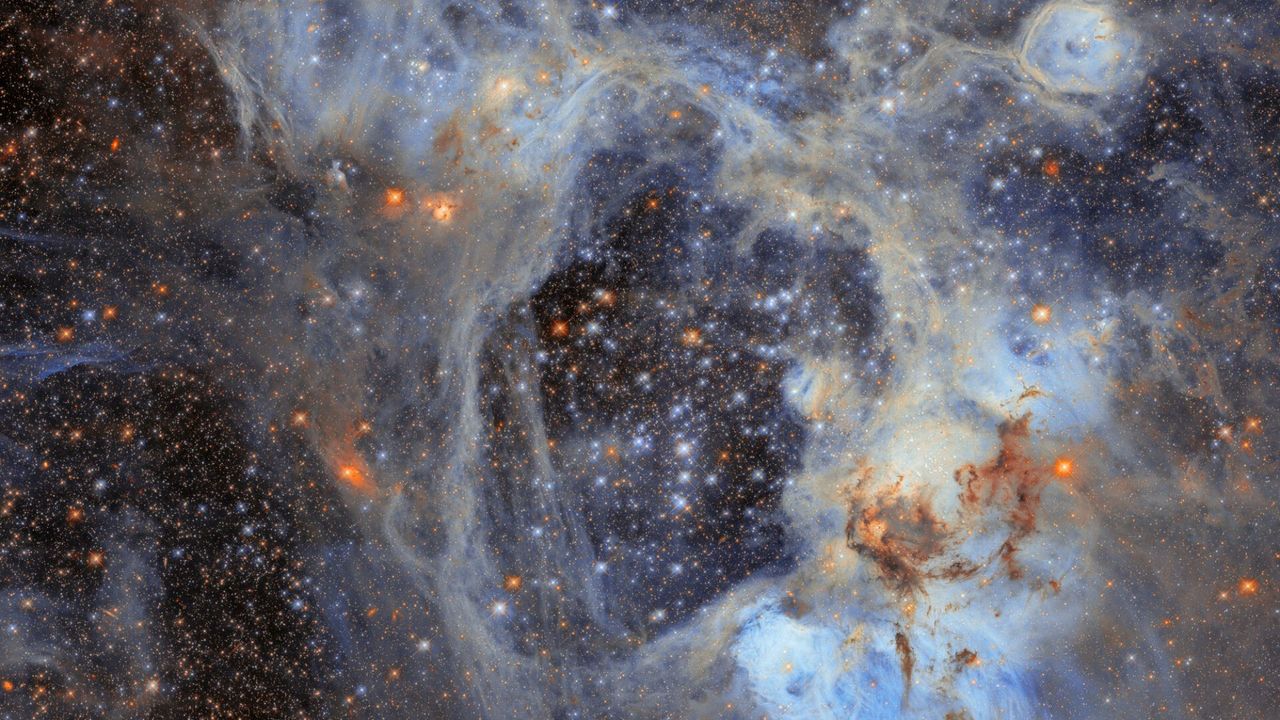
The enchanting scene comes courtesy of the Large Magellanic Cloud.
When you purchase through links on our site, we may earn an affiliate commission. Here’s how it works.
About 160,000 light-years away lies one of our Milky Way's little galactic neighbors: The Large Magellanic Cloud (LMC). And thanks to a new observing program, the Hubble Space Telescope has provided us with an intricate image of a nebula in the LMC. The surprising part? There's a giant void at the center. Scientists call it a "superbubble."
What you're seeing in this image is a nebula within the LMC known as LHA 120-N44, or simply N44. It's located in the constellation of Dorado and, like a classic nebula, is the site of stars being born at a noticeably rapid rate.
But of course, what really can't be missed is the huge hole at the center of N44's dusty tendrils — this is the "superbubble," and its dimensions are staggering. NASA says it's about 210 by 140 light-years across — a truly unimaginable size, considering the distance between our sun and Pluto isn't even a single light-year.
One light-year, the distance light travels in a year, is about 6 trillion miles (9.7 trillion kilometers).
The superbubble is a bit of a mystery, but one theory of why it exists is that stars at the center of the bubble could have undergone supernova explosions or have released stellar winds that swept away gas in the nebula. This could have resulted in a "void," as NASA calls it, surrounded by a gaseous shell. That would explain away the image we see pretty well, but there will likely be studies dedicated to refining that story.
Of note, in that shell around the superbubble, stars continue to form and show themselves as beautiful little specks across the watercolor-like landscape.
Something else interesting about this image is that N44 is what's known as an "emission nebula," meaning the gas you see has been energized by stars in the area. This enhances the luminescent quality of the portrait.
This is because the energization process, or ionization to be specific, generates ionized gas that ultimately must cool down. During that cooling, it goes from a higher energy state to a lower energy state and thus releases some energy. This energy loss causes N44 to glow brightly, creating the beautiful scene we see.