// KOTAKU — GAMING
The Drifter Is A Dark Pulp Horror Game With Stunning Art
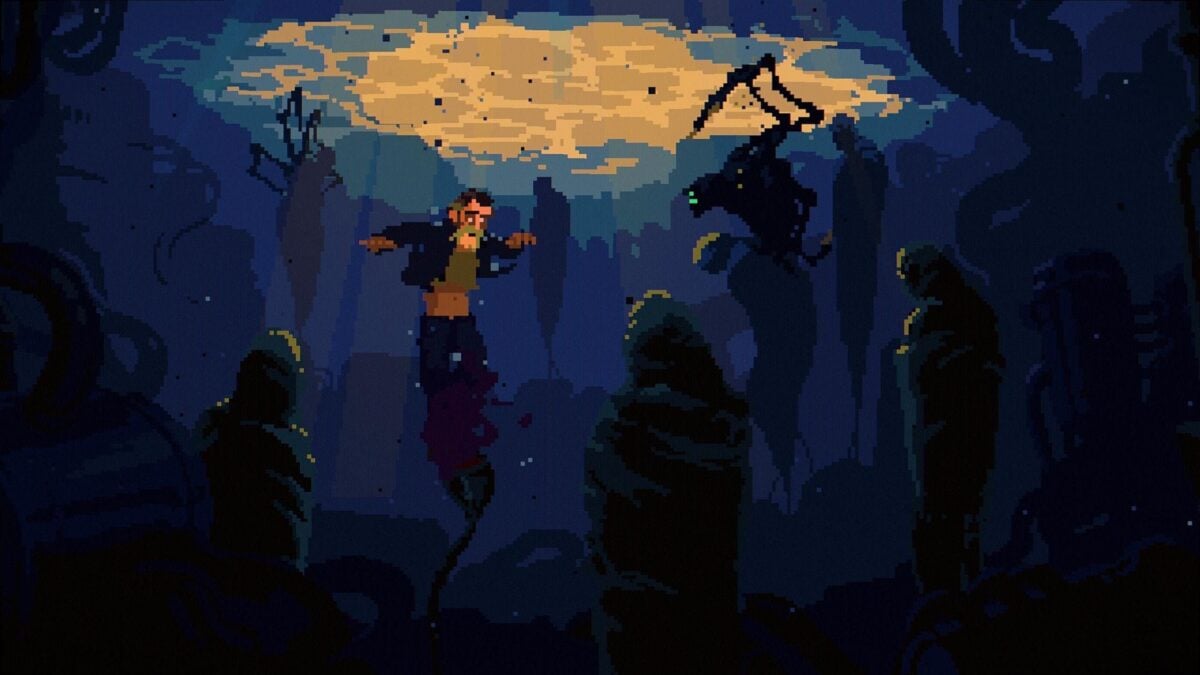
It’s odd how rare it is to hear an Australian accent in a video game. In point-and-click adventure The Drifter, however, you’ll hear a lot of them, along with some superb Aussie vernacular. The Drifter is a lengthy tale of an itinerant man who, on discovering he cannot die, becomes entangled in a conspiracy of monsters, murder, and reluctant family.
These impressions were originally published on Jul 22, 2025. We’re sharing them again this week because The Drifter just came to the Nintendo Switch and Switch 2.
Mick Carter has mostly given up. Since the death of his son, he’s walked out on his wife and chosen to live a drifter’s life. However, his mother’s just died and his sister has insisted he come back home for her funeral. So, riding a boxcar, he arrives back in town, where he’s immediately confronted by armed men who shoot and kill a fellow traveler. Scrambling to escape, Mick finds himself in an abandoned tunnel by a canal, and must immediately solve some point-n-click puzzles to survive—fix a car engine with some hose, find some fuel, that kind of thing, alongside talking to an old homeless friend as well as a cub reporter from a local paper.
Except, it’s a bluff. It’s a fascinating move by developers Powerhoof, who have previously given us multiplayer dungeon crawler Crawl and bonkers party game Regular Human Basketball—two games utterly unlike each other and unlike this latest. Because Mick Carter isn’t going to fix the car, on account of being murdered.
He wakes up—is that the right term?—underwater, his feet tied to a rope coming up from the bottom of the canal, and if you don’t act fast, he drowns. And then wakes up (?) again, in the situation. Each death is agony, utter trauma, and in the white expanse that interrupts his moments of being alive is only more pain. Things have taken an odd turn.
Once you escape this, Mick still has to attend a funeral, with family relying on him to not let them down this one time, but clearly things are somewhat fraught. And so properly begins the nine-chapter story of his attempt to uncover the conspiracy that has brought him to this place, with help from his sister, wife, and various oddballs he encounters on the way. Oh, and now his dead son is showing up and giving him advice, and there’s no way of knowing just how much Mick is losing his mind.
This excellent opening, and indeed fantastic extended middle, is superb. Self-described as “pulp,” the story is deliberately outlandish, but grounded by Mick’s down-to-earth working class Aussie attitude. The acting by the entire cast is fantastic, and it’s quite something when you learn, as the credits roll, that so many of those distinctive characters were voiced by the same people. Mick is voiced by Adrian Vaughan (more usually an art lead on games like Civ VII), who I had no idea was also behind another six characters, some of them major roles. Rhiannon Moushall (Old Skies, Dragon Quest III: HD-2D) also puts in a triple-shift, and a special shout-out goes to Shogo Miyakita (Rise of the Rōnin, Space Marine II) for his fantastic performance as D.I. Hara, one of the most interesting characters in the game.
The pixel art is also absolutely stellar. Powerhoof’s pixel chops are the one consistent theme through their disparate games, and completely stunning here. Every scene is beautifully painted in a way reminiscent of classic LucasArts, and the character animations are bespoke and meticulous. The game always looks incredible, even when it’s taking place in an abandoned sewer tunnel.
So yes, there are so many good things to say about this game. You may have spotted, however, that I praised its opening and middle, but left out its ending. That’s not quite as damning as it might suggest, but it does speak of my incredulity as the plot progressed. Obviously I’m not going to give any spoilers (I’ve deliberately avoided telling you key themes of the game because they’re not revealed until the middle act), but it all gets so incredibly si