// SPACE.COM — SPAZIO & SCIENZA
On this day in space! Sept. 7, 1995: NASA launches its 100th astronaut flight on space shuttle Endeavour's STS-69 mission
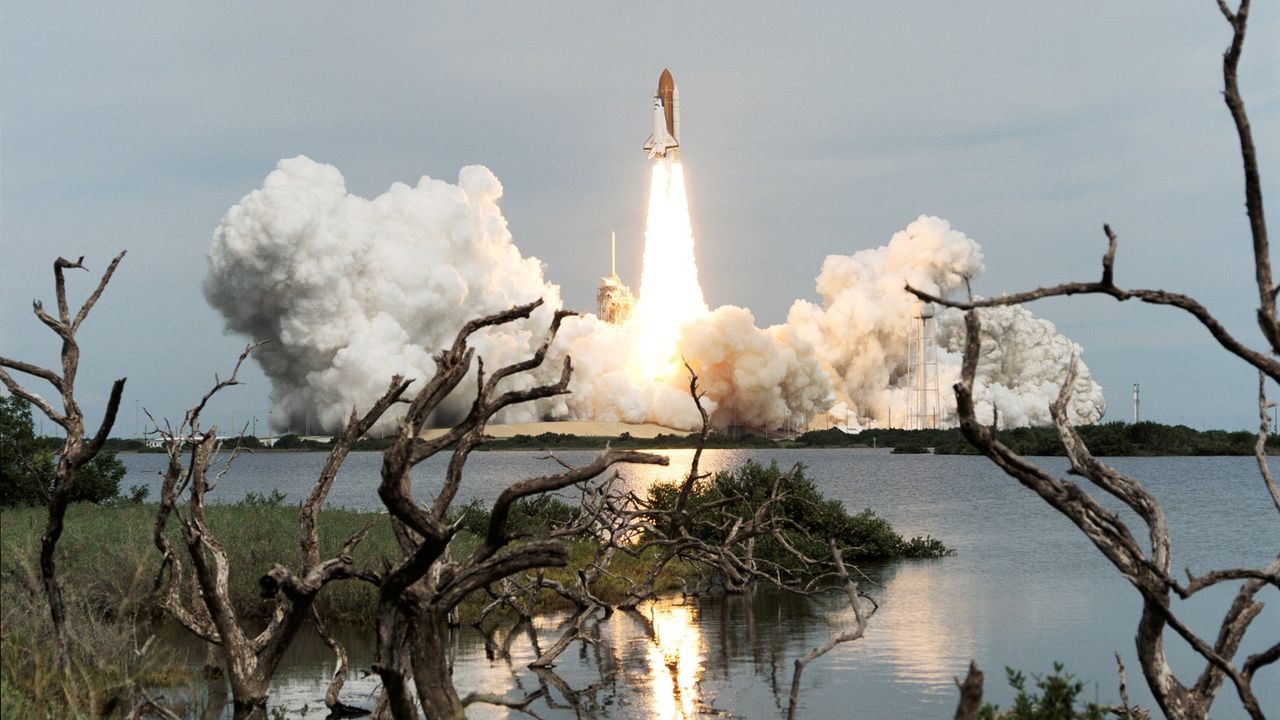
For the first time in NASA history, a space shuttle deployed two different payloads for space science.
When you purchase through links on our site, we may earn an affiliate commission. Here’s how it works.
On Sept. 7, 1995, the space shuttle Endeavour launched on mission STS-69. This was the 100th successful crew spaceflight mission for NASA.
Endeavour lifted off from NASA's historic Pad 39A launch site at the Kennedy Space Center in Florida. During the 11-day mission, five crewmembers did science experiments, deployed and retrieved a satellite called Spartan 201, and conducted a nearly seven-hour-long spacewalk to practice methods future astronauts would use to build the International Space Station.
The astronauts also deployed the Wake Shield Facility, a saucer-shaped satellite that flew free of the shuttle for several days. This was the first time two different payloads were retrieved and deployed during the same mission.
The launch of STS-69 on space shuttle Endeavour was a milestone of sorts for NASA and U.S. space exploration. As the 100th crewed flight by NASA astronauts, it showed that flying humans in space was not a one-off or occasional feat.
The five-astronaut crew was commanded by David Walker, with Kenneth Cockrell as pilot. Astronaut Jim Voss served as payload commander (remember, this was the first time two different payloads would be deployed in space), with astronauts Jim Newman and Michael Gernhardt rounding out the team as mission specialists.
The Spartan 201-03 payload was an experiment designed to study the sun's outer atmosphere as it transitioned into solar wind. It was the third of four such Spartan 201 flights on a NASA space shuttle.
The Wake Shield Facility-2, meanwhile, was a sort of in-space factory. The saucer-shaped platform was actually a stainless steel disk designed to create an "ultravacuum environment" in space in order to grow thin films that could be used for new advanced electronics. The disk was actually deployed twice during the 11-day mission and successfully grew four thin films of seven planned, while also performing an electrical field experiment for the U.S. Air Force on its second deployment.
The one spacewalk of the mission was performed by astronauts Voss and Gernhardt, who spent 6 hours and 46 minutes working outside Endeavour to test new thermal upgrades to NASA's extravehicular activity (or EVA) suits, as well as new tools and techniques to build the then nascent International Space Station.