// SPACE.COM — SPAZIO & SCIENZA
Going supersonic! NASA's X-59 jet breaks sound barrier for the 1st time
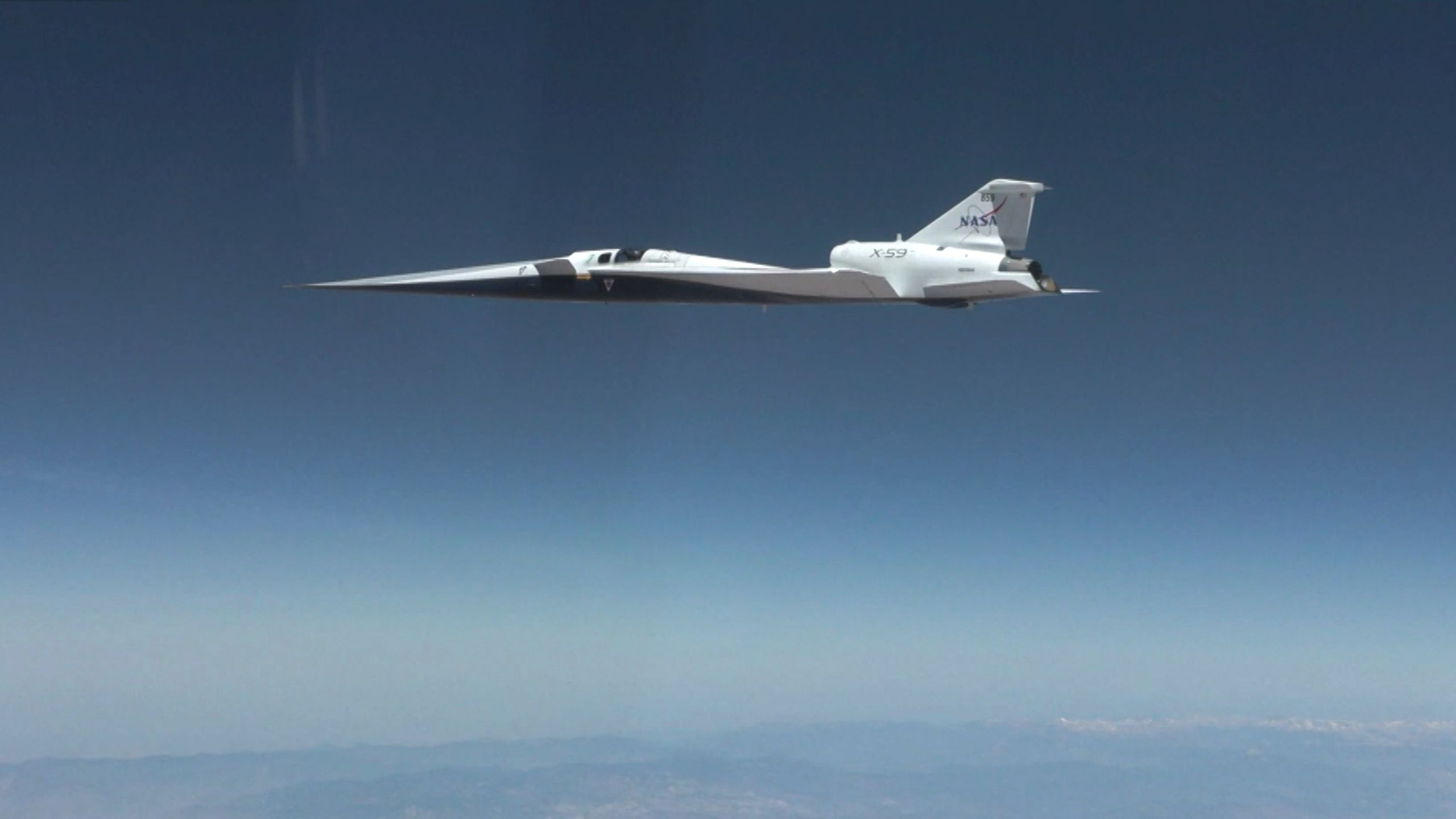
"The X-59’s first supersonic flight is a testament to America's enduring leadership in science, engineering and aerospace innovation."
When you purchase through links on our site, we may earn an affiliate commission. Here’s how it works.
The X-59, a long-nosed demonstrator designed to help develop the tech required for "quiet" supersonic flight, notched the milestone on Friday (June 5), more than six months after getting off the ground for the first time.
"The X-59’s first supersonic flight is a testament to America's enduring leadership in science, engineering and aerospace innovation," Michael Kratsios, assistant to the president for science and technology and director of the U.S. Office of Science and Technology Policy, said in a statement on Friday.
Friday's flight began and ended at Edwards Air Force Base in California. The X-59, with NASA test pilot Jim "Clue" Less at the yoke, took off at 2:08 p.m. EDT (1808 GMT; 11:08 a.m. local California time) and touched down 81 minutes later.
Less took the jet to a maximum altitude of 43,400 feet (13,228 meters) and a top speed of 713 mph (1,147 kph). That works out to about Mach 1.1, or 1.1 times faster than the speed of sound, NASA officials said in the statement. (The speed of sound varies with temperature, as sound waves move faster in warmer air. At sea level, where the air is relatively warm, Mach 1 is about 761 mph, or 1,225 kph.)
X-59 team members won't rest on their laurels, however. In just a few days, they plan to send the plane on its first "mission conditions" flight — one that reaches a top speed of Mach 1.4 and an altitude of about 55,000 feet (16,764 m).
"This speed and altitude are the base conditions for the X-59 when it will eventually fly over several U.S. communities, enabling NASA to gather data about how people may perceive its quiet thump," NASA officials wrote in the same statement.
"NASA will share this data with U.S. and international regulators to help establish new data-driven noise standards to enable a future viable market for supersonic commercial flight over land," they added.
That market dried up in 1973, when the Federal Aviation Administration banned such flights to protect people and property from loud sonic booms.