// HACKER NEWS — CYBERSECURITY
Show HN: MultiMatte, a Promptable Image Background Removal Model
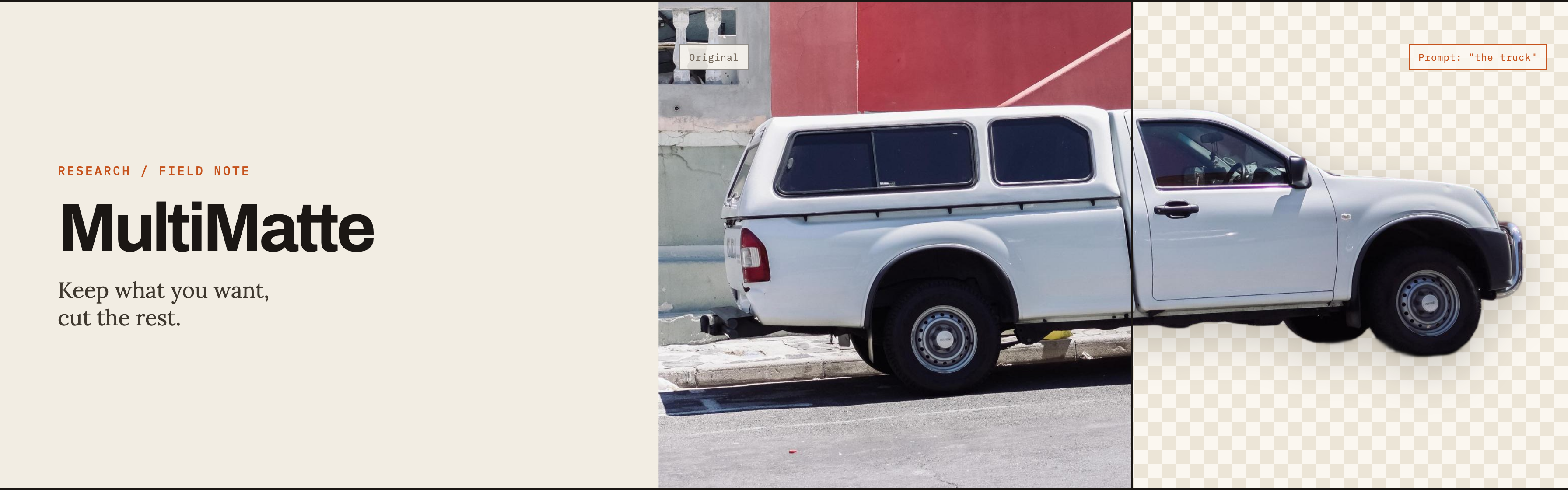
We’re introducing MultiMatte, a background removal model you can aim with words. MultiMatte keeps the object you name and removes everything else.
Try MultiMatte on your own images at usefeyn.com/multimatte.
MultiMatte is built on SAM 3 (Meta, 2025). We used low-rank fine-tuning to modify 19.49M of its 860M parameters. That update touches only 2.27% of the model weights, yet MultiMatte improves substantially on image segmentation. On the DIS-VD benchmark, it scores a 0.901 S-measure against SAM 3’s 0.667.
SAM 3 is a concept-promptable detector. Given a phrase, the model returns binary masks for every matching object. These masks classify each pixel as either inside or outside the object. This binary approach fails on fine or translucent elements with fuzzy boundaries, like hair or a blurred screen.
MultiMatte addresses this gap with alpha mattes. Instead of assigning a boolean to each pixel, an alpha matte assigns a continuous opacity value to every pixel. Fuzzy boundaries can then be described as they actually appear.
Alpha mattes earn their keep on benchmarks. Across five high-resolution DIS splits, SAM 3 scores between 0.649 and 0.703. MultiMatte scores between 0.893 and 0.923.
SAM 3 is not one network but several aligned parts: a vision tower, a CLIP text tower, a geometry encoder, a detection encoder and decoder, and a mask decoder. The ability to aim the model with a phrase lives in the alignment between those parts. Our objective was to carry this ability over to matting.
We trained the model with PEFT, using LoRA (Hu et al., 2021). Every targeted linear layer kept its pretrained weight frozen and learned two small matrices that added a low-rank update alongside it. Training this way let us retain SAM 3’s text alignment and original vocabulary while improving its segmentation ability.
The rank-16 adapter followed the configuration principles in Thinking Machines’ LoRA analysis (2025). It targeted the attention and MLP projections in every tower, including the CLIP text tower. We merged the final adapter into the released weights, so inference doesn’t require a separate adapter library.
The training run used 19,953 images spanning salient objects, camouflage, high-resolution subjects, hair, and marine scenes. We trained for 14,000 steps with the semantic segmentation objective SAM 3 already uses: focal loss (Lin et al., 2017) plus Dice loss.