// SPACE.COM — SPAZIO & SCIENZA
NASA is paying $30 million for a 1st-of-its-kind rescue mission to the aging Swift telescope before it falls from space. Is it worth it?
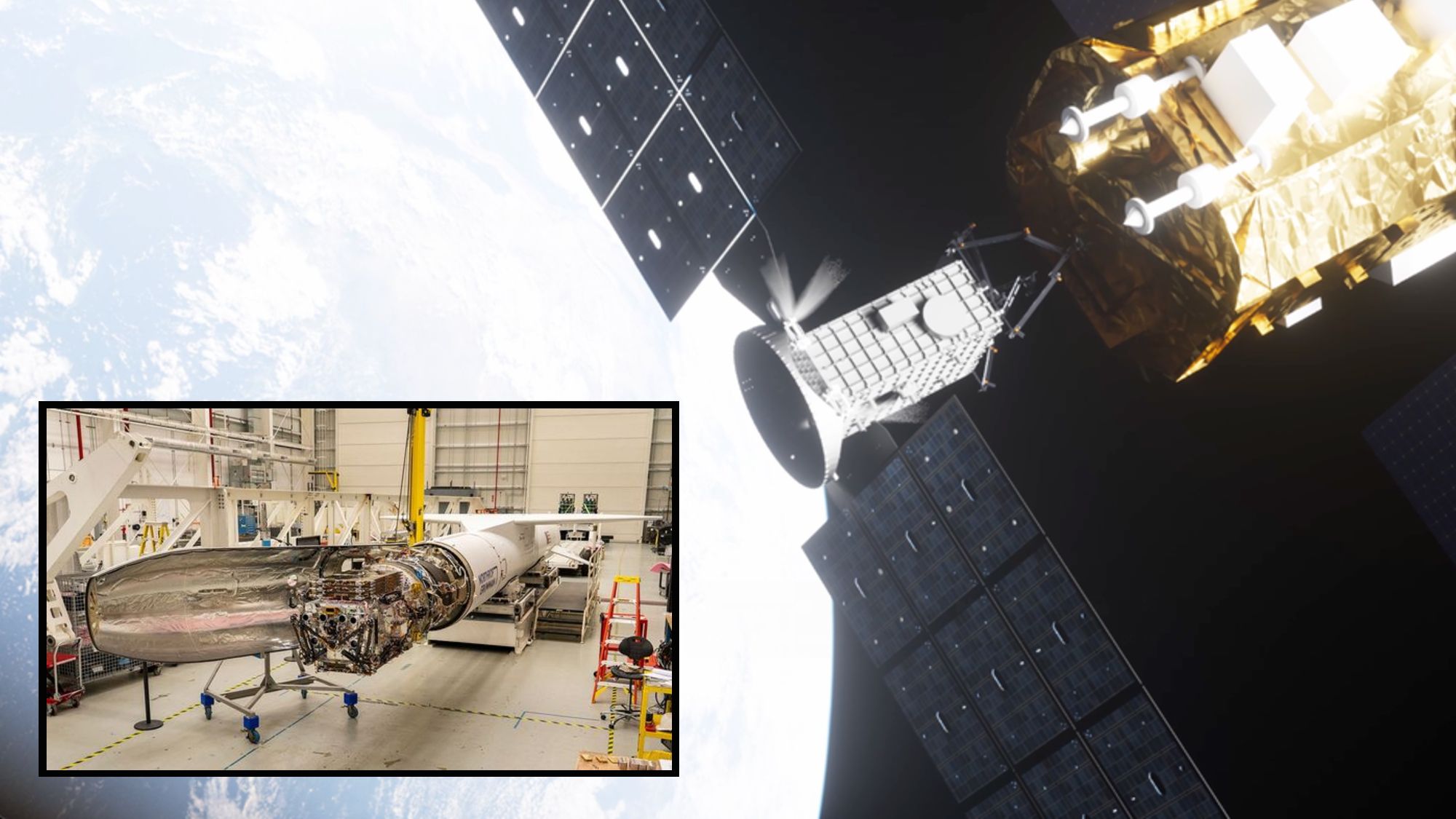
NASA's daring Swift Boost mission launches June 27 to save the nearly 22-year-old Swift observatory , which is being dragged out of space by Earth's atmosphere.
When you purchase through links on our site, we may earn an affiliate commission. Here’s how it works.
On paper, it seems like the math would be clear. A nearly 22-year-old space telescope, well past its prime, is falling out of space after decades of hunting the biggest explosions in the universe. Rest in peace, right?
After all, it would cost NASA $30 million to save the telescope, called the Swift Observatory, which the agency launched in 2004 on a planned two-year mission. Some of us have cars that we've replaced far sooner for much less. And now, higher-than-expected drag on the satellite from Earth's outer atmosphere (caused by solar storms) will pull Swift out of orbit by year's end. So why not accept the inevitable fiery demise of the observatory when it plunges back to Earth?
Swift, it turns out, is still worth it, according to NASA. The observatory has spent over two decades as a sort of orbital sentinel that scans the cosmos for gamma-ray bursts, ready to quickly point itself at the short-lived — but insanely powerful — space explosions at a moment's notice. No other off-Earth observatory, not even the famed Hubble Space Telescope or James Webb Space Telescope, can perform such a feat of astronomy. So NASA is launching a rescue mission on June 27, one led by the company Katalyst Space using its new Link spacecraft.
"We didn't want to set the precedent that anything that comes out of orbit has to be boosted, because it is part of our space ecosystem to have things deorbit frequently," Shawn Domagal-Goldman, NASA's Astrophysics Division director, told reporters during a Swift rescue mission briefing on June 17. "But this was not just any spacecraft; this is an observatory with unique capabilities for astrophysics … It is a swift observatory that can quickly pivot across the night sky to find things that go boom in the night."
NASA originally built and launched Swift in 2004 for $250 million. Since then, the observatory has served as a first responder of sorts to rapidly spot distant gamma-ray bursts that can last mere seconds, yet unleash more power than our sun will in its entire lifetime. Because of its success, Swift's mission has been extended repeatedly.
"The name is not an acronym. It comes from the ability to rapidly and autonomously repoint its narrowfield X-ray and UV [ultraviolet] telescopes almost anywhere on the sky," Swift Principal Investigator Brad Cenko told reporters during the June 17 briefing. (NASA renamed Swift the Neil Gehrels Swift Observatory in 2018 after the mission's first principal investigator, who died a year earlier.)
"The universe is a very dynamic place. Somewhere in the cosmos, a massive star explodes every second," he added. "And over time, our exceptional operations team, led by Penn State, has found new and innovative ways for the satellite to rapidly respond to these discoveries."
The Hubble Space Telescope can capture sharper photos than Swift, but it takes up to two days to point Hubble at a new target, Cenko said. It takes Swift mere minutes. "It really is NASA's first responder, and by working together in this complementary manner, the NASA astrophysics portfolio can tackle questions that would be impossible for any single facility to answer," Cenko added.