// NATURE NEWS — SPAZIO & SCIENZA
Road transport of trapped antiprotons
Nature
(2026) Cite this article
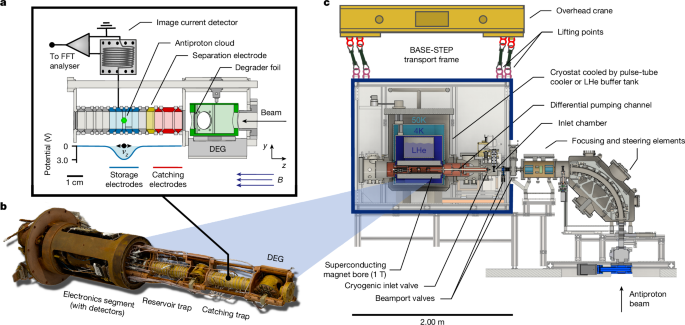
Low-energy antiprotons confined in ultrahigh-vacuum Penning traps1 enable precision investigations of charge, parity and time-reversal (CPT) invariance2 to test the fundamental symmetry between matter and antimatter. These studies are driven by the search for physics beyond the standard model of particle physics, including efforts to explain the observed cosmological matter–antimatter asymmetry. Until now, such experiments have only been possible at CERN’s Antimatter Factory3,4. At present, magnetic-field fluctuations caused by the facility operation limit the sensitivity of trapped-antiproton precision measurements5, which provide the most stringent matter–antimatter symmetry tests in the baryon sector6,7,8,9. This has inspired us to develop the cryogenic, open and transportable Penning-trap system BASE-STEP5,10, designed to relocate antiprotons into low-noise offline laboratories, a strategy expected to enable at least 100-fold improved CPT tests9,11. Here we demonstrate the road transport of antiprotons trapped in BASE-STEP. Ninety-two trapped antiprotons have been transported outside the Antimatter Factory along a 7.5-km route without particle loss or measurable degradation of the trap vacuum. This achievement marks the starting point for a new era of antiproton precision measurements8,12 in dedicated low-noise offline laboratory environments.
Experiments that compare the properties of matter–antimatter conjugates13,14 test the fundamental CPT invariance, which is deeply intertwined with our understanding of energy, space-time and causality15,16. As such, it constitutes a cornerstone of the relativistic quantum field theories of the standard model, and any observed difference would point to physics beyond it. Particularly compelling are experiments involving stable matter–antimatter systems, such as electrons and positrons17,18, protons and antiprotons6,7,8,9 or hydrogen and antihydrogen19,20. Stored in ultrahigh vacuum, the intrinsic stability of these systems permits non-destructive measurements21,22 at exceptionally long interrogation times11 and ultrahigh fractional precision, enabling sensitivity to potential minute signatures of exotic phenomena beyond established physics23,24,25,26,27,28.
In the BASE collaboration, we use an advanced cryogenic Penning-trap system to perform CPT invariance tests by high-precision comparisons of the fundamental properties of protons and antiprotons, such as charge-to-mass ratios q/m and magnetic moments6,7. These are extracted from single-particle measurements of the cyclotron (νc) and spin-precession (νL) frequencies, both proportional to the magnetic field B. Using the BASE trap system in the CERN Antimatter Factory (AMF), we have achieved relative uncertainties at the level of 16 parts per trillion for the charge-to-mass ratio6,9 and 1.6 parts per billion7,8 for the magnetic moment, constraining CPT-violating effects down to sensitivities of 2 × 10⁻²⁷ GeV (ref. 9). However, these measurements are ultimately limited by fluctuations of B at the experiment location in the AMF, which directly contribute to the measurement uncertainty5. Our efforts to mitigate these limitations have included the development of the reservoir trap technique29,30, enabling precision measurements when the AMF is offline, typically for two to three months per year9. Combined with improved magnetic shielding31, this strategy has boosted the frequency stability and enabled our latest results11; further improvements toward parts-per-trillion measurements require long-term systematic studies extending well beyond annual shutdown periods and, consequently, years of data taking. Other Penning-trap systems in magnetic noise-free environments achieved g-factor difference measurements with 5.6 × 10⁻¹³ relative uncertainty32, high-precision magnetic moment measurements33 and 10−12 level uncertainties in q/m measurements34,35 on much shorter timescales. In