// NATURE NEWS — SPAZIO & SCIENZA
Scalable near-real-time Bayesian phylogenetics for outbreaks with Delphy
Nature
(2026) Cite this article
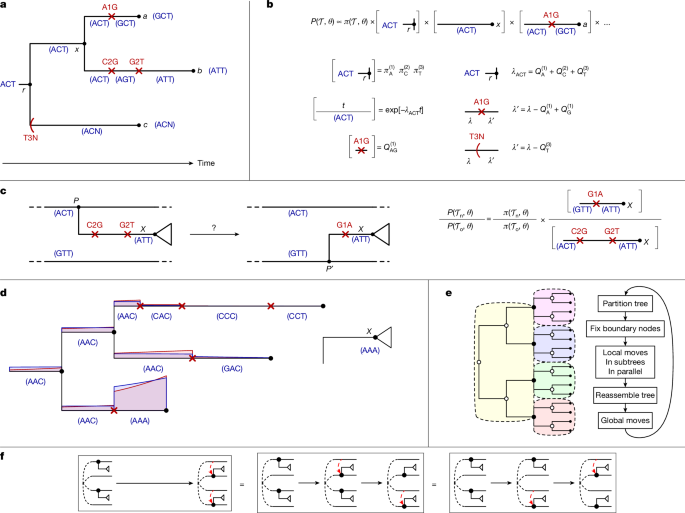
Pathogen genomic analysis is central to tracking, understanding and containing outbreaks1,2,3,4,5,6,7,8,9,10,11,12,13, but the complexity and cost of state-of-the-art phylogenetic tools limit global access and impact. Here we introduce Delphy, an exact reformulation of Bayesian phylogenetics14,15,16,17 designed to transform its speed, scalability and accessibility while retaining Bayesian state-of-the-art accuracy. Delphy’s central data structure, an explicit mutation-annotated tree, takes advantage of the high sequence similarity of large-scale epidemic datasets18,19,20 for efficient tree exploration and convergence. By reproducing key analyses from recent major epidemics, including Ebola1,21, Zika2, SARS-CoV-2 (ref. 22), mpox3,4 and H5N1 (refs. 23,24), we demonstrate state-of-the-art accuracy with up to 2–3 orders of magnitude improvements in speed. Assessing Delphy’s scalability, we show that a simulated dataset of 100,000 sequences can be analysed within a day. We distribute Delphy as a client-side web application that enables local, interactive analysis of raw data on the user’s machine. Delphy automatically identifies key viral lineages and mutations, as well as their emergence and prevalence through time, with quantified uncertainties grounded in Bayesian theory. Delphy establishes Bayesian phylogenetics as a fast, accessible frontline tool for future outbreak response.
Large-scale sequencing of pathogen genomes, now routine using next-generation sequencing, provides considerable clarity into pathogen spread and evolution during outbreaks. However, the resulting massive datasets—illustrated by over 17 million publicly available SARS-CoV-2 genomes25—pose an equally substantial challenge to analyse and interpret.
Phylogenetics is a fundamental tool for organizing and interpreting pathogen genome sequences, inferring plausible trees of descent among sampled pathogens. Phylogenetic reconstruction enables diverse analyses, including (1) dating the start of outbreaks1,2,3; (2) distinguishing zoonotic spillovers from human-to-human transmission1,4; (3) identifying major lineages5; (4) detecting early warning signs of concerning new lineages13; (5) revealing community-based and geographically based spread patterns4,6,7,8; and (6) reconstructing detailed transmission networks9,10,11,12.
Among phylogenetic approaches, Bayesian phylogenetics, as implemented in widely used tools such as BEAST X14, BEAST2 (ref. 15), MrBayes15,17 and RevBayes16, is the most flexible and reliable, and underpins outbreak reconstruction and phylodynamics. Phylogenetic reconstruction has inherent uncertainties, which Bayesian methods quantify, simultaneously inferring other latent variables such as geographical spread4 or viral population dynamics4,26.
Despite its advantages, Bayesian phylogenetics remains technically complex and resource intensive. A handful of specialized research groups can handle this complexity, but it remains inaccessible to most epidemiologists and public health bodies. Bayesian techniques are so computationally expensive that outbreak-tracking infrastructures (such as NextStrain27 and Cov2Tree28) rely on approximate methods, such as maximum parsimony18,29 or maximum likelihood30,31. These methods typically generate a single tree topology, then post-process it with ad hoc techniques to infer uncertainties and latent variables9,27,32,33.
When applying Bayesian phylogenetics to nearly identical sequences, large computational gains are possible by reformulating calculations around local mutations rather than all mutated sites. This exact reformulation is always possible, but should be especially efficient when mutations are sparse. Outbreak sequences often differ from their closest related sequence at as few as 0 to 2 sites18,19,20, and therefore clearly exhibit such sparsity.
Recent work exploiting low outbreak sequence diversity has substantially improved the perfo