// NATURE NEWS — SPAZIO & SCIENZA
Assessing biological degradation of non-hydrolysable synthetic polymers
Nature
volume 657, pages 611–620 (2026) Cite this article
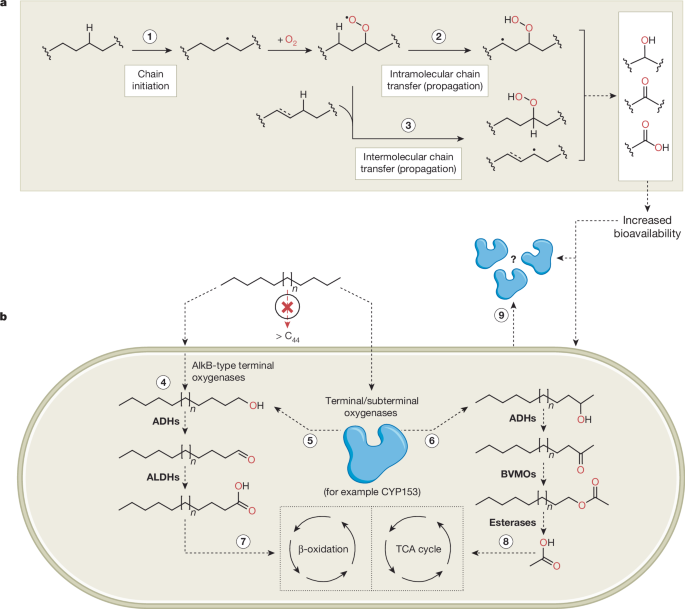
The discovery and engineering of enzymes capable of depolymerizing synthetic polymers with hydrolysable backbone linkages is now enabling biotechnological solutions for plastics recycling. Polyolefins and other non-hydrolysable polymers, however, have saturated carbon–carbon linkages that are more challenging to cleave biologically. Despite decades of research, the evidence that biocatalysts can appreciably deconstruct carbon–carbon-linked polymers remains ambiguous, often stemming from inconsistent assays and qualitative, low-resolution analytical methods and from the lack of proper identification and biochemical characterization of the enzymes involved. To aid in definitive polymer deconstruction measurements for non-hydrolysable polymers, here we survey abiotic and biological oxidation mechanisms and provide critical commentary on experimental assays and substrate and product characterization approaches. From this foundation, we propose best-practice experimental design principles, including reaction conditions, control experiments, analytical approaches, biochemical assays and characterization methods that should promote reproducibility and impact across this field.
This is a preview of subscription content, access via your institution
Access Nature and 54 other Nature Portfolio journals
Get Nature+, our best-value online-access subscription
Prices may be subject to local taxes which are calculated during checkout
Borrelle, S. B. et al. Predicted growth in plastic waste exceeds efforts to mitigate plastic pollution. Science 369, 1515–1518 (2020).
Article
ADS
CAS
PubMed
Google Scholar
Stubbins, A., Law, K. L., Munoz, S. E., Bianchi, T. S. & Zhu, L. Plastics in the Earth system. Science 373, 51–55 (2021).
Article
ADS
CAS
PubMed
Google Scholar