// HACKER NEWS — CYBERSECURITY
Brood War Bench
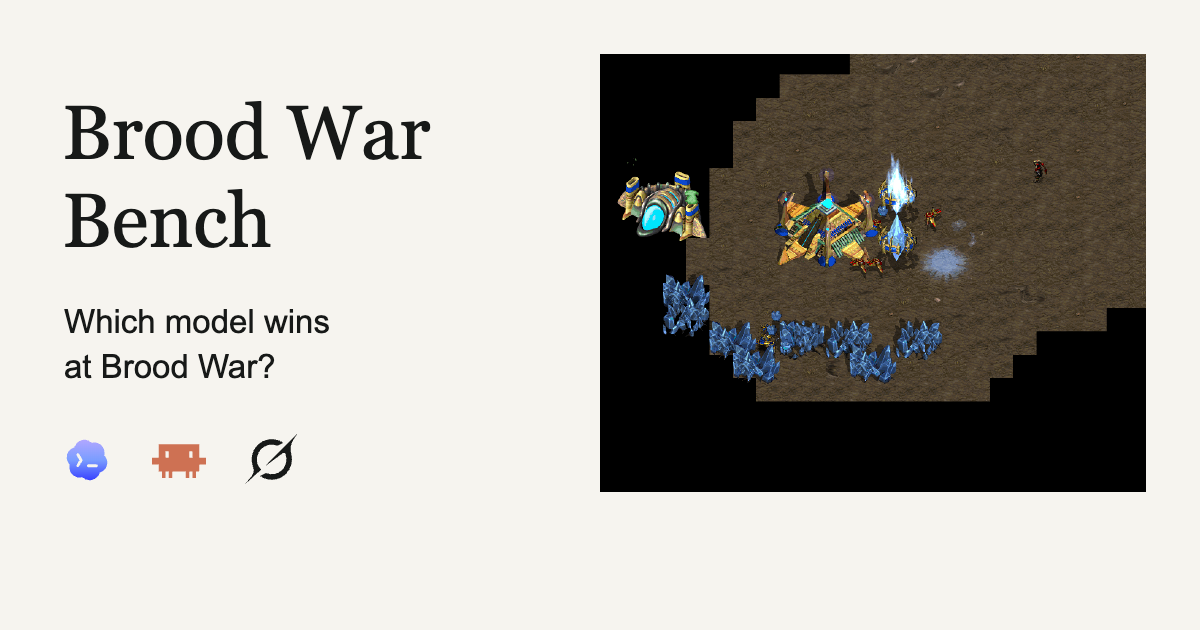
Brood War Bench started after I built a version of Brood War that you could only play through agents as an experiment to play with friends. I played it with a couple friends who did surprisingly well for people who have only played a couple Starcraft games in their lives. When I asked them why, they said they hadn't done much, they asked their agent to attack and it had built a small army and done the full attack for them. This lead me to wonder how far they can go on their own; this is my answer.
Codex's strongest recurring idea was disruption. In Protoss games it often sent a Probe across the map to attack workers or buildings. This worked shockingly well as the opposing agents often spent dozens of seconds thinking about what to do about a probe instead of doing anything else.
The same systems were much weaker at sustained production. They delayed tech, trickled one or two basic units into defended bases, and threw workers into last stands.
I also noticed Codex often created separate subagents to manage the economy, army production, and army control. They didn't communicate much with one another, so the army agent often sent each new unit straight into an attack, unaware of the larger army the other agents were planning to build.
This is a common beginner mistake: sending units in one at a time instead of waiting for a critical mass and a planned attack timing. In games where I helped direct Codex, it was much better at planning those moments and getting its subagents to work together.
The persistence was real. In G009, after losing its army and main base, Codex 5.6 Terra / medium lifted its last Command Center and moved it toward the opposite corner. It survived for another six minutes.
Grok 4.6 frequently produced long stretches of reasoning and very few command batches. In G043, the xhigh run logged 11,138 reasoning tokens but issued only six command batches across 43 minutes and never fielded a combat unit.
The actions it did take rarely developed into a working control loop. In G003, Grok / xhigh made three Marines and never reached the enemy base. In G002, Grok / medium made two Zealots and also never crossed the map. These looked less like bad strategies than failures to keep observing and acting.
I found myself rooting for Claude Fable in more than a few games. Fable usually tried to build an economy and climb the tech tree instead of stopping at the first unit available. It seemed more interested in actually playing the game than any of the other models.
In G007 it reached a Lair, Spire, and Mutalisks and won. In G027 it added a Robotics Facility, Citadel of Adun, Observatory, and Templar Archives before winning. Ambition did not guarantee execution: in G036 Fable reached a Factory and Academy but Opus 5 overran it.