// ARS TECHNICA — CYBERSECURITY
Don't call it an SUV: The Ferrari Purosangue review
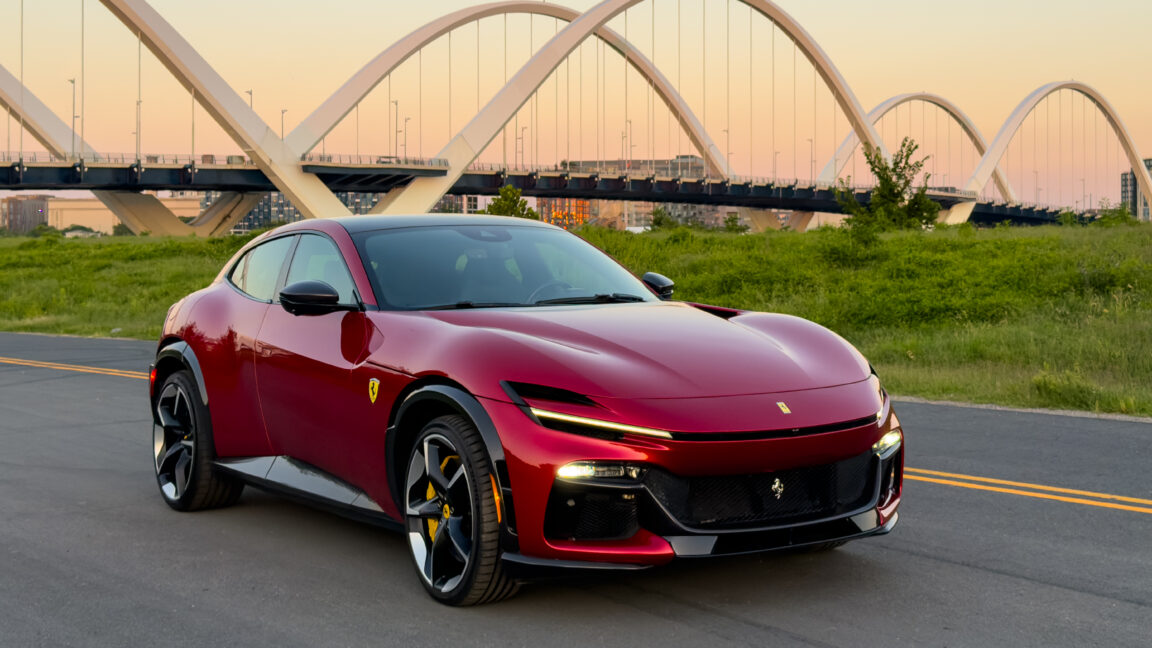
Unlike previous Ferrari four-seaters, this one is better for humans than cargo.
Ferrari’s two-seat sports cars might be the brand’s identity, but the Italian automaker has always catered to customers who want to bring more than one passenger along for the ride. It started building cars with back seats in the 1960s with the 250 GT 2+2; as the name suggests, the second row was more for occasional use, something that was true all the way through to the 612 in the early 2000s. Ferrari followed with its first true four-seater, the all-wheel drive FF, which adopted “Breadvan” styling. Its first hatchback was still a three-door, though, and slightly more practical for carrying cargo rather than humans in the rear. That was true for the GTC4 that followed, too. But with the Purosangue, the rear passengers have been given something of an upgrade.
For one thing, there is an extra pair of doors, rear-hinged ones that provide direct access to the pair of rear bucket seats. There’s still a rear hatch, so this is technically a five-door. But there’s an immovable firewall between the cargo area and the passenger cabin, and the rear seats do not fold flat. So unlike the 21st century breadvans we have previously reviewed, a Costco run in the Purosangue might be possible, but you’re probably going to want a roof rack if you plan to go skiing, cycling, or anything else that requires bulky equipment. It’s also probably accurate that Ferrari says the Purosangue is not an SUV but an FUV—a Ferrari Utility Vehicle.
Underneath that long hood lives a 6.5 L naturally aspirated V12, but mounted back in the chassis such that this is technically a front-mid engined layout. That contributes to the 49:51 front-to-rear weight ratio, as does the use of a transaxle gearbox for the rear wheels (an eight-speed, dual-clutch box); a separate power transfer unit at the front of the engine drives the front wheels, for this is an all-wheel drive Ferrari. But make no mistake, it’s a substantial one, too, befitting that massive 715 hp (533 kW), 528 lb-ft (716 Nm) engine: 195.8 inches (4,973 mm) long, 79.8 inches (2,028 mm) wide, 62.6 inches (1,589 mm) tall, with a 118.1-inch (3,018 mm) wheelbase and a 4,784 lbs (2,170 kg) curb weight.
Despite that size, it doesn’t take very long for the car to shrink around the driver; earlier this summer, I spent a couple of hours driving another Purosangue around Rome on the eve of Ferrari’s Luce reveal, where it coped quite ably with millennia-old streets. It’s an easy car to drive slowly or in traffic despite its size and power output. The stop-start system works even from cold and is unobtrusive, and your speed is easy to modulate thanks to plenty of pedal travel for the throttle and an engine with sufficient torque that you’ll rarely see more than 2,000 rpm on the digital tachometer if you’re in Comfort mode and letting the eight-speed transmission shift for itself.
Which is something, considering the fact that the engine doesn’t redline until 8,250 rpm. You’ll probably want to be in Sport to experience that; it’s the most extreme of the Purosangue’s settings, for you won’t find a Race mode on the steering wheel-mounted manettino dial that toggles through drive modes, although you will find one for Ice instead. Regardless of the mode, you can choose to change gears for yourself using the large and tactile paddle shifters, either to temporarily override the auto function or in true manual mode, selectable via a switch on the center console, where you’ll also find reverse.
The steering is heavier than something like a 296 but still feels very direct, with good feedback of the road conditions as the front wheels are experiencing them. In Sport, you can feel the chassis control systems and the electronic differentials doing their thing to tighten your line if you’re steering and adding power at the same time. And because there are four seats, you can share the experience with three passengers: The squeals of delight from happy y