// NATURE NEWS — SPAZIO & SCIENZA
Daily briefing: The first new cat species described by science in a century
Search author on:
PubMed
Google Scholar
Hello Nature readers, would you like to get this Briefing in your inbox free every day? Sign up here.
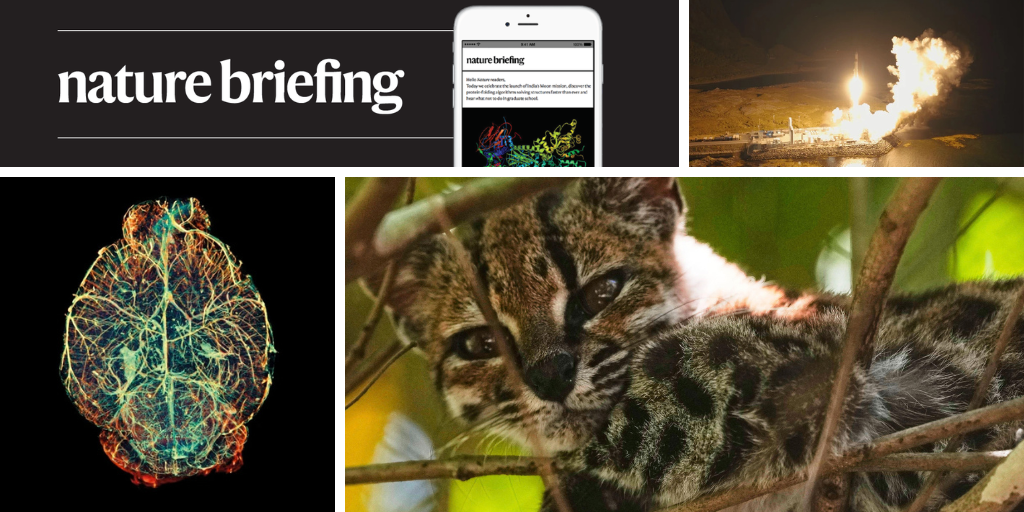
Blood vessels (artificially coloured) snake through a a mouse’s brain.Credit: Simon Walker-Samuel, UCL CABI/Science Photo Library
A new study suggests that two types of precursor cells are required to build the brain, challenging a decades-long theory that a single type of starter cell gives rise to the complex organ. The research finds that one type of precursor cell forms the hindbrain, while another generates the forebrain and midbrain. Not all researchers are convinced by this conclusion, but the work has drawn broad praise for one aspect: the authors found an efficient way to coax stem cells to grow into hindbrain motor-neuron cells, which could aid research into conditions that affect these cells, such as amyotrophic lateral sclerosis (ALS).
Europe is taking steps to develop its own sovereign space capabilities, and wean itself off its dependence on infrastructure from the United States. Europe currently relies on NASA and companies such as SpaceX to launch some of its astronauts and satellites to space. But at a summit in Paris earlier this month, leaders such as French president Emmanuel Macron and European Commission president Ursula von der Leyen expressed a desire to bolster Europe’s autonomy in space. Some countries, such as Germany, have also increased their spending on space-based defence technologies.
Leopardus tilcayo is smaller than a housecat, covered in leopard-like spots and the first new cat species to be described by science in more than 100 years. What’s more, genetic analysis suggests that the group of South American tiger cats to which tilcayos belong, once thought to be one species, is more like five — with implications for conservation. “If you think [the tiger cat] is a single thing from southern Brazil all the way to Costa Rica, you’re going to find it’s not endangered,” says geneticist and study co-author Eduardo Eizirik. “But if we find that it’s not a single thing, but actually five things, each of them must be assessed separately.”
The felid’s proposed scientific name originates from its common name, tilcayo, among the people who live alongside it in Bolivia’s Yungas forest. (Juan Karita/AP via Alamy)
Artificial intelligence systems that generate hypotheses, design experiments and analyse data, such as Google’s Co-Scientist, are revolutionizing how researchers work — and could change how scientists are valued. The aim of these systems is to free up researchers from the “routine aspects of discovery”, says geneticist Le Cong, co-founder of biomedical AI start-up Phylo. But doing so could deprive students and early-career researchers of opportunities to develop their skills, and require that scientists have unusually far-reaching knowledge to judge whether AI-generated ideas are sound.
The claim last week by AI company OpenAI that its system had solved a high–profile physics conundrum — demonstrating that the Navier–Stokes equations don’t always work for incompressible fluids — raised plenty of questions about the impact of AI on mathematics, such as who gets the credit. But what does it mean for fluid dynamics? Brush up on your mastery of turbulence and flow in this overview.
“People often experience climate change not as a single disaster, but as gradual erosion of health, livelihoods, social cohesion and dignity,” writes clinical psychologist and public-health researcher Manasi Kumar. “Mental health sits at the centre of those losses, yet remains mostly invisible in the systems designed to address them.” When people can’t adapt; when communities are ripped apart — “harms should be measured and institutions should be held accountable in addressing these harms”, Kumar argues.