// HACKER NEWS — CYBERSECURITY
Unreal Agent
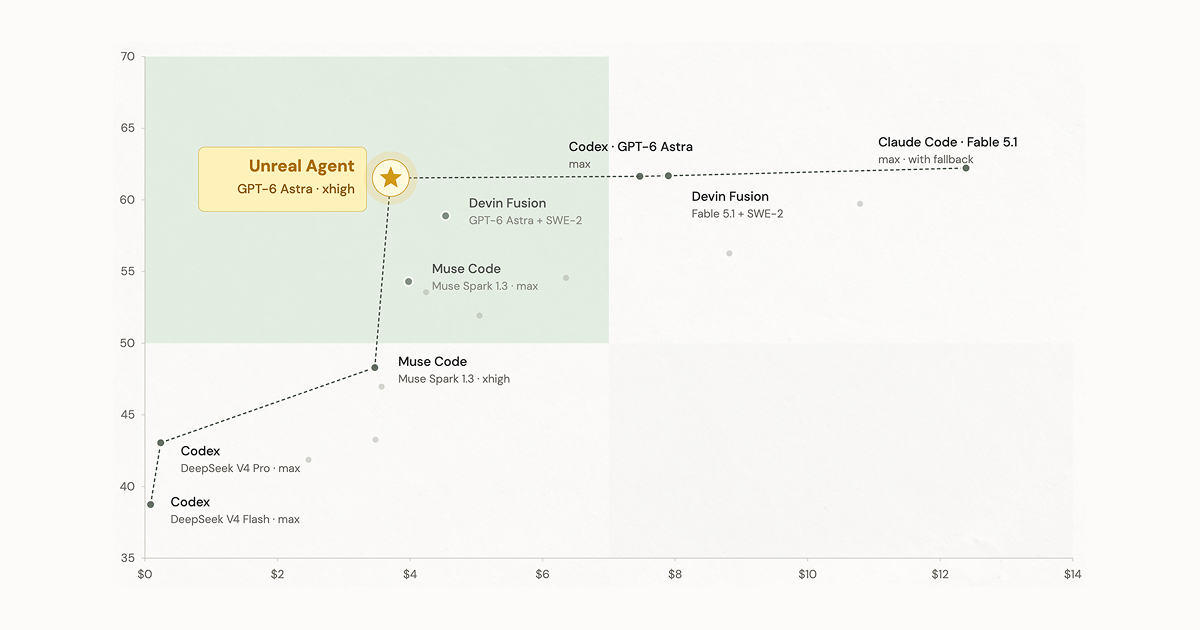
We’re sharing Unreal Agent — an agent harness that delivers up to 40% cost savings compared to Codex on production workloads and coding/science benchmarks, without any negative performance impact.
If you’re interested in frontier cost-efficiency for your AI agents, we’d love to work together! Get in touch: contact@unreallabs.ai.
While deploying agents in the wild, we wanted them to respond to users quickly and be cost-effective to run. We’ve noticed that agents spend a lot of time and tokens managing tool calls, which motivated us to build Unreal Agent with a harness that would reduce the model’s tool-management overhead.
The Unreal Agent harness manages tool calls in a completely asynchronous way, relieving the underlying model of the need to manage waits, polls, and heartbeats for tools.
This approach drives two major benefits. First, it always allows users to steer the agent without the need to wait for tool calls to finish. Second, it allows the agent to schedule more useful tool call work between model calls, driving frontier cost efficiency. The current version achieves up to 40% cost savings compared to Codex and up to 20% compared to Pi in real workloads and on agentic benchmarks, which we share here.
We believe harness design is a research area in its own right, with many promising ideas still to be researched and implemented.1
If you try to build an agent-first product, you’ll quickly realize that there’s no golden path for implementing one. Big-brand vendors offer different SDKs to build agents, each with a different set of trade-offs that might not be immediately apparent.
At Unreal Labs, we have built a number of agentic products and learned a few things about popular SDKs along the way.
For example, CLI-oriented SDKs such as Claude’s Agent SDK carry assumptions about local sessions, subprocesses, and resource limits that don’t translate neatly into production use. Handling completion, cancellation, and background tasks reliably often means building your own lifecycle management around them.
Supporting other providers adds compatibility work: switching API modes can break tools or compaction, while SDK upgrades can change message formats and force integration rewrites. Heavy dependency trees add maintenance and supply-chain risk to a runtime we already need to understand and patch ourselves.