// NATURE NEWS — SPAZIO & SCIENZA
In praise of human teachers: universities must resist outsourcing everything to AI
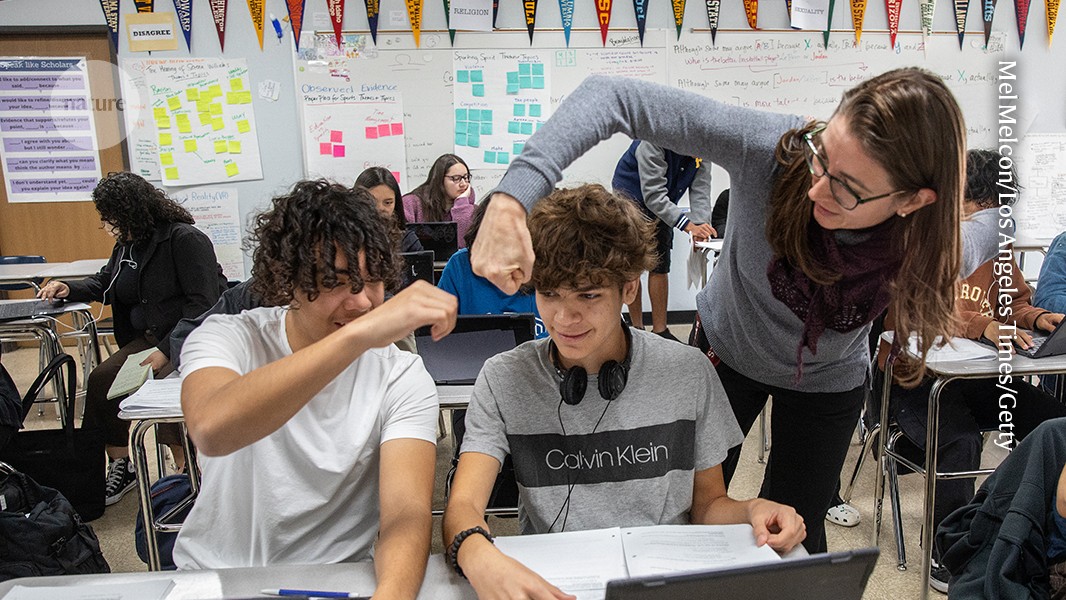
The role of teachers will be essential in imparting excitement about learning as students get to grips with using AI tools.Credit: Mel Melcon/Los Angeles Times/Getty
Will artificial intelligence damage the ability of humans to think critically? This has become an urgent question for those involved in education, from early-years teachers to trainers of experienced working people. For universities, the question is existential. Teaching students how to think, and why that thinking is important, is core to a university’s mission and purpose. Many research leaders, potential students, parents and carers are asking if there is any point in working towards a qualification if someone can answer a complex question or write an essay using a few chatbot prompts. The same question arises when considering that teachers can use AI tools to mark assignments without engaging with content.
How to stay smart in the age of AI: the science of critical thinking
We tackle this and other questions in a News Feature, which reports on the literature about AI and critical thinking. With studies at an early stage, it is too soon to draw definitive conclusions. But AI use is widespread, and teachers are already reporting signs that chatbots are reducing opportunities for thinking and reasoning.
Universities around the world are deep in preparation for what they expect to be a revolution in teaching, learning and assessment, perhaps even greater than the introduction of personal computers, e-mail and the Internet.
As part of these preparations, last month, the Massachusetts Institute of Technology (MIT) in Cambridge announced the results of a review of AI use by its staff and students (see go.nature.com/4h4ajx6). “Not surprisingly, students told us the temptation was greatest when they feared they would miss a deadline,” its report says. It adds that there will need to be “substantial adaptation to survive an encounter with AI without serious disruption”.
Universities are starting to incorporate AI tools into learning and teaching, and using them for tasks that were previously done by humans. For instance, chatbots are answering questions that a student might ask university administrative staff in their first week. A few universities are experimenting with AI-generated lectures.
AI tools are also providing feedback on coursework submissions. According to researcher Thomas Corbin, who studies assessment and digital learning at Deakin University in Melbourne, Australia, one of the benefits that students report is that they don’t have to wait for feedback — it is instant and available around the clock.
Science must protect thinking time in a world of instant communication
What is essential while this transition happens, as the MIT report emphasizes, is to retain the human teacher’s guiding role in showing students how to learn to think as they are using AI. That means teachers still need to be up to speed with their students’ progress, even when feedback is outsourced to AI tools. There can be no shortcuts to this, as the Nobel-prizewinning economist Philippe Aghion said earlier this month at a Nature Conference in Paris on AI in health care: “We need schools in which we learn to learn.”