// NATURE NEWS — SPAZIO & SCIENZA
Lu+ optical frequency references with accuracy verified at the 19th digit
Nature
(2026) Cite this article
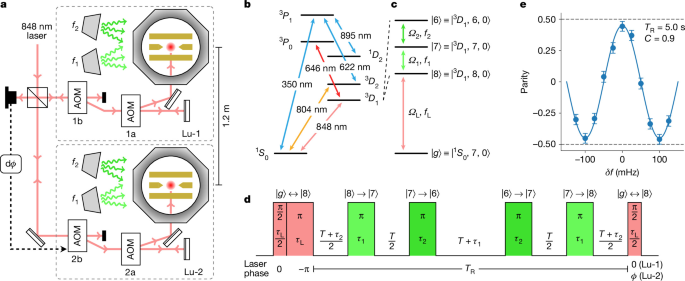
Optical atomic frequency references1 have far surpassed their microwave frequency predecessors, leading to an anticipated redefinition of the SI (International System of Units) second2. However, as the scientific community seeks consensus on a new standard, and several state-of-the-art optical standards now report evaluated fractional uncertainties below 10−18, verification by same-species comparisons to comparable levels remains an outstanding challenge. Here we report two 176Lu+ single-ion optical frequency references, each with evaluated fractional frequency uncertainty near 1 × 10⁻¹⁹, which are directly compared by correlation spectroscopy and demonstrate agreement, with a measured relative frequency difference of [−0.1 ± (5.7)stat ± (1.0)sys] × 10−19, where ‘stat’ and ‘sys’ indicate the statistical and systematic uncertainty, respectively. Our optical references have been comprehensively assessed with evaluated uncertainties below 10−18, supported by a same-species comparison of independent systems to the 5.7 × 10⁻¹⁹ level. This accuracy, achieved in practical room-temperature systems, will contribute to improving international timekeeping and towards chronometric levelling3,4 at the millimetre scale, as well as tests of fundamental physics5 such as Lorentz invariance6, general relativity7, searches for dark matter8,9 and variation of fundamental constants10,11.
As the international scientific community seeks consensus on a new standard for redefinition of the SI (International System of Units) second (ref. 2), it is essential that the uncertainty budgets of optical standards are both rigorously evaluated and experimentally tested through comparison. Although several state-of-the-art optical standards now report evaluated fractional uncertainties below 10−18 (refs. 12,13,14), same-species comparisons to experimentally test these claims are relatively few6,7,15,16. Meanwhile, inter-species comparisons at the highest precision have shown significant inconsistencies relative to reported uncertainty budgets17,18,19,20. An evaluated uncertainty budget is a quantitatively testable prediction that two frequency standards of the same species, corrected for their evaluated systematic shifts, should agree to within their combined uncertainties. In this work, we test that prediction directly by adhering to three criteria for a rigorous assessment of our optical frequency standard21: (1) a clear set of experimental measurements of atomic properties and environmental factors determining the systematic uncertainty budget; (2) a same-species comparison to demonstrate validity of the uncertainty budget to the degree the measurement precision allows; and (3) a stress test on any systematic that is substantially larger than the measurement precision of the comparison, that is, a frequency comparison in which the systematic is deliberately shifted and observed to give the predicted shift in the clock frequency. Applying these criteria, we report one of the first comprehensive characterization of all known sources of systematic uncertainty for two independent 176Lu+ single-ion optical references, each with evaluated systematic uncertainty near 1 × 10⁻¹⁹, a fourfold improvement on the lowest previously reported12,14. Their agreement is verified at the level of 5.7 × 10⁻¹⁹, limited by the comparison precision, after 200 h of averaging.
The exceptionally low systematic uncertainty is possible because of the relative insensitivity of the 176Lu+ 1S0 ↔ 3D1 transition to perturbations compared with other leading contenders. In particular, this transition has the lowest sensitivity to blackbody radiation (BBR) and magnetic fields of any established clock system, and the large atomic mass makes it less susceptible to motional shifts than lighter atomic species. The complete uncertainty assessment, summarized in Table 1, builds on several recent advances, including an improved method for