// NATURE NEWS — SPAZIO & SCIENZA
A design approach for bitopic kinase inhibitors
Nature
(2026) Cite this article
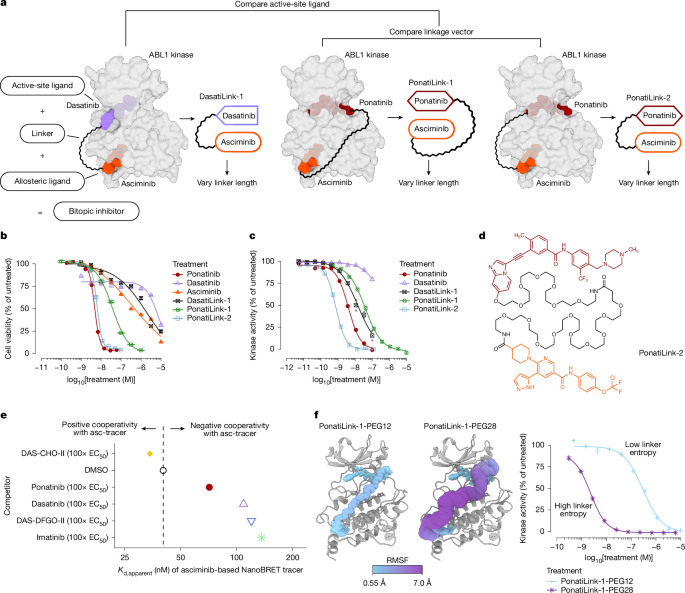
Traditional kinase inhibitors face a trade-off between potency and selectivity because their affinity depends on limited molecular interactions in a single highly conserved binding site. Bitopic inhibitors overcome this limitation by engaging multiple sites on the same target1. Here, using ABL1 and EGFR as model kinases, we systematically explore the bitopic-specific design parameters of ligand choice, linkage vector and linker length and show that they affect potency through inter-ligand cooperativity and linker entropy. We apply this approach to address an unmet clinical need: existing inhibitors of ABL1, an important target in BCR::ABL1-driven leukaemias, are constrained by resistance mutations and off-target effects2. The third-generation inhibitor ponatinib overcomes many resistance mutations, but cardiovascular toxicity limits its clinical use3. We design a bitopic ABL1 inhibitor, PonatiLink-2, that maintains or surpasses the potency of ponatinib against resistance mutants. Moreover, it has an enhanced therapeutic window in vitro and in vivo, which enables increased dosing without apparent toxicity. PonatiLink-2 outperforms clinically relevant treatments in mouse models of BCR::ABL1-driven cancer, both in combination with dasatinib against wild-type BCR::ABL1 and as a single agent against ponatinib-resistant disease. These findings indicate that the bitopic design approach is a promising strategy for developing potent, well-tolerated clinical inhibitors of ABL1 and other targets.
Kinases control many fundamental cellular processes, and their dysregulation underlies many diseases. Small-molecule kinase inhibitors were among the first targeted cancer therapies, and many have been introduced since imatinib was approved in 2001 for chronic myeloid leukaemia (CML) driven by the BCR::ABL1 fusion gene4. However, kinase inhibitors often face challenges from resistance mutations and off-target effects that limit their clinical utility.
Linked molecules, built from two affinity ligands connected by a flexible tether, have emerged as a versatile molecular design strategy in recent decades5. Although most linked molecules have been developed to engage two different proteins, bitopic inhibitors bind two distinct sites on the same target1,6. By engaging a larger binding interface, bitopic inhibitors can potentially achieve both higher potency and greater selectivity than conventional single-site inhibitors.
Early bitopic kinase inhibitors linked ATP-competitive ligands to peptide ligands7,8,9, but poor cell permeability limited their therapeutic potential1. More recently, linked molecules that connect two drug-like ligands have demonstrated favourable cellular activity, particularly proteolysis-targeting chimeras10. Our group has designed bitopic inhibitors of mTOR kinase that engage its ATP site directly and its FRB domain through FKBP1211, leading to the development of one of the first bitopic kinase inhibitors to enter clinical trials: RMC-555212,13. Recently, we presented a proof-of-concept bitopic inhibitor of ABL114), a target that exemplifies the promises and challenges of kinase inhibitors.
The BCR–ABL1 fusion tyrosine kinase drives nearly all CML2 and around 30% of adult acute lymphoblastic leukaemia (ALL)15, which is also associated with other ABL1 and ABL2 fusions16,17. Although tyrosine kinase inhibitors (TKIs), such as imatinib, have substantially improved patient outcomes in CML18, two major challenges remain. First, most patients require lifelong therapy, and only approximately 20% of all patients with CML achieve treatment-free remission19,20. Second, resistance mutations, particularly in the ATP-binding site2,21, can render TKIs ineffective.
The third-generation TKI ponatinib addresses single-nucleotide resistance mutations of BCR::ABL1, including T315I2,22. However, this TKI has a US Food and Drug Administration boxed warning for serious cardiovascula