// NATURE NEWS — SPAZIO & SCIENZA
A new chapter in targeting kinase enzymes in cancer
Alice T. Shaw is in the Department of Medical Oncology, Dana-Farber Cancer Institute and at Harvard Medical School, Boston, Massachusetts 02215, USA.
Search author on:
PubMed
Google Scholar
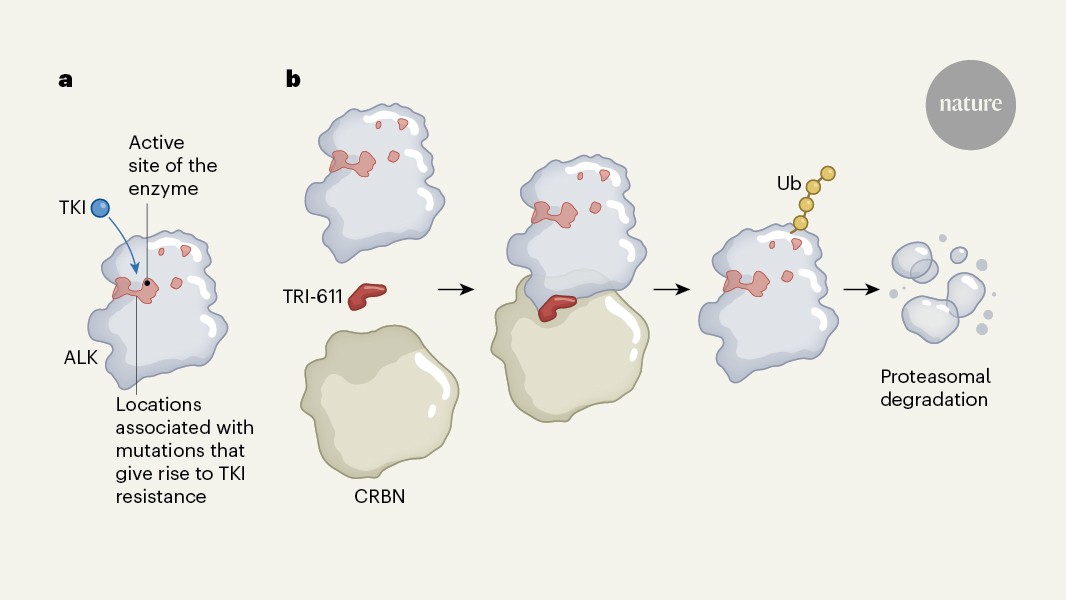
Targeted therapies have led to striking improvements in outcomes for people who have advanced cancer. Small molecules that inhibit the function of kinase enzymes that have acquired cancer-promoting activity have been particularly effective at treating lung cancer. Twenty-eight kinase inhibitors have been approved by the US Food and Drug Administration for nine molecular subsets of the disease. Although these inhibitors can result in cancer remission, in some cases lasting years, many people’s cancers eventually return. This is often because the kinase has acquired changes in amino-acid residues at or around the kinase’s active site, causing resistance to the drug. Writing in Nature, Conery et al.1 report an alternative and potentially powerful approach to treating these cancers that eliminates the target kinase rather than just inhibiting its function.
Access Nature and 54 other Nature Portfolio journals
Get Nature+, our best-value online-access subscription
Prices may be subject to local taxes which are calculated during checkout
Otano, I., Ucero, A. C., Zugazagoitia, J. & Paz-Ares, L. Nature Rev. Clin. Oncol. 20, 143–159 (2023).
Article
PubMed
Google Scholar
Article
PubMed
Google Scholar
Kwak, E. L. et al. N. Engl. J. Med. 363, 1693–1703 (2010).