// SPACE.COM — SPAZIO & SCIENZA
The growing number of satellites in orbit could soon make telescopes obsolete. 'For astronomy, this would obviously be catastrophic'
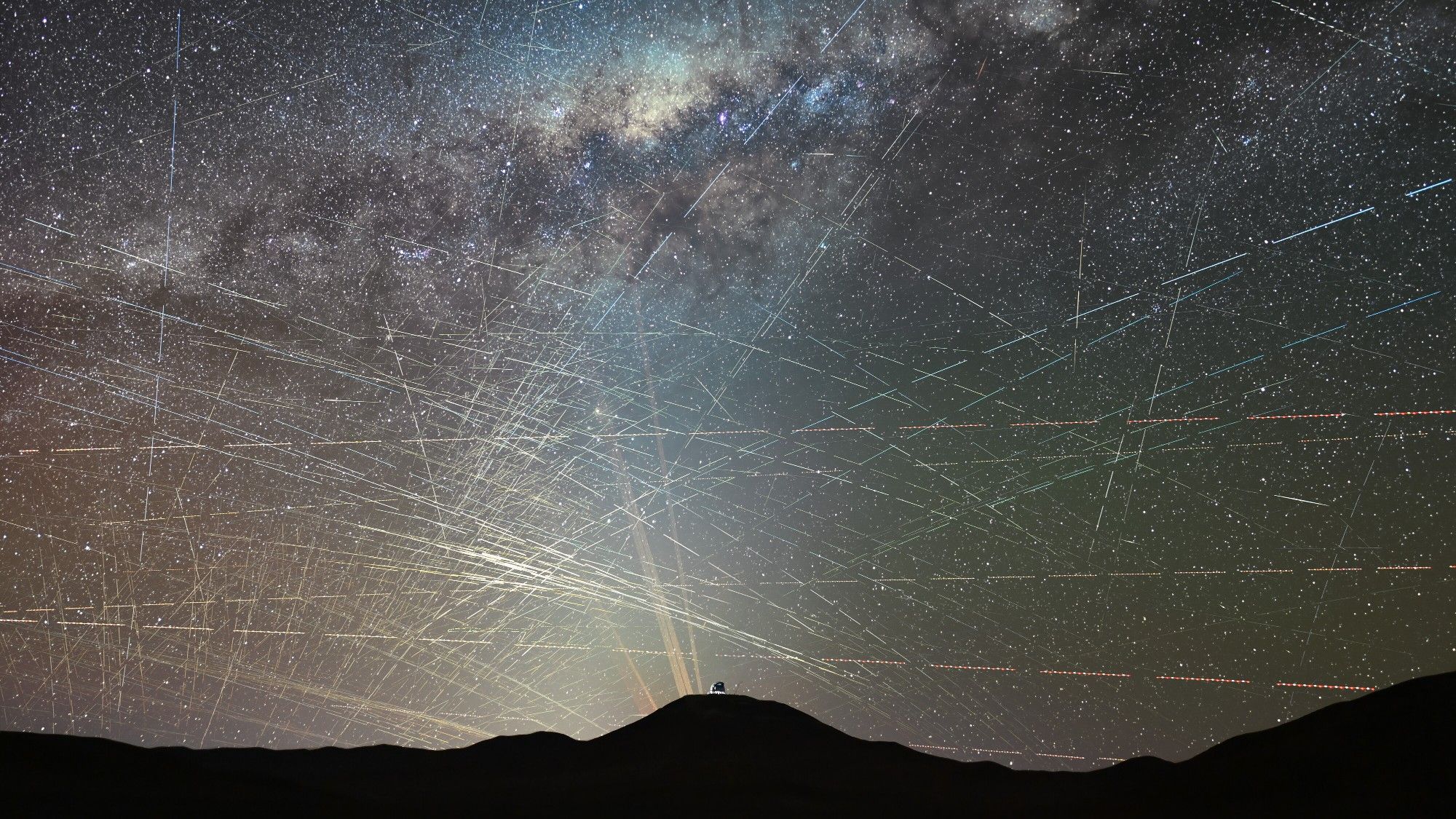
"The public has not signed up for having an entirely transformed sky."
When you purchase through links on our site, we may earn an affiliate commission. Here’s how it works.
If the number of satellites in Earth's orbit exceeds 100,000, humanity may lose its ability to study the universe from the planet's surface.
That's the conclusion of a study conducted by astronomers from the European Southern Observatory (ESO) which warns that if existing plans to deploy a million orbiting data centers and tens of thousands sun-reflecting mirrors were to come to fruition, the world's most cutting-edge astronomical telescopes may as well be mothballed.
"We can reach conditions where basically, there is no point in operating the telescopes anymore because all the data will be corrupted. All. 100 percent," Olivier Hainaut, the director of operations at ESO and lead author of the study, told Space.com.
Hainaut used computer modelling to understand the effect of varying numbers of satellites of different brightness levels on astronomical observations. The modelling showed that if 100,000 satellites were to orbit the planet and all were barely visible to the naked eye, astronomy could cope. If those satellites were brighter, however, around magnitude 7 or below in astronomical terms, astronomical research would become more difficult and costly.
Satellites affect the sky in two ways. Firstly, the sunlight they reflect increases the overall brightness of the sky, creating light pollution. Second, brighter satellites also create streaks in telescope images that mar observations.
"If you increase the light pollution, it means that you will see fewer natural stars and you will see more of these satellites," said Hainaut . "For telescopes that means increasing exposure times. If you have a 10 percent increase in light pollution, you have to increase all the exposure times by 10 percent. It scales directly. For a 100 percent increase in light pollution, you have to increase all the exposures by 100 percent."
The exposure time increases mean that less science gets done and every observation becomes more expensive. The International Astronomical Union says that an increase in light pollution by more than 10 percent compared to natural dark sky conditions is an astronomy killer.
As light pollution has spread with urban development over the past two centuries, astronomers have increasingly been retreating into ever more remote locations. Many of the world's most expensive telescopes, including the Vera C. Rubin Observatory and the ESO's Very Large Telescope and Extremely Large Telescope, are located in Chile's Atacama Desert where the night sky is still nearly perfectly dark.