// NATURE NEWS — SPAZIO & SCIENZA
2D semiconductor aims to turbocharge development of high-performance electronics
Taoyu Zou is in the Department of Chemical Engineering, Pohang University of Science and Technology, Pohang 37673, South Korea.
Search author on:
PubMed
Google Scholar
Yong-Young Noh is in the Department of Chemical Engineering, Pohang University of Science and Technology, Pohang 37673, South Korea.
Search author on:
PubMed
Google Scholar
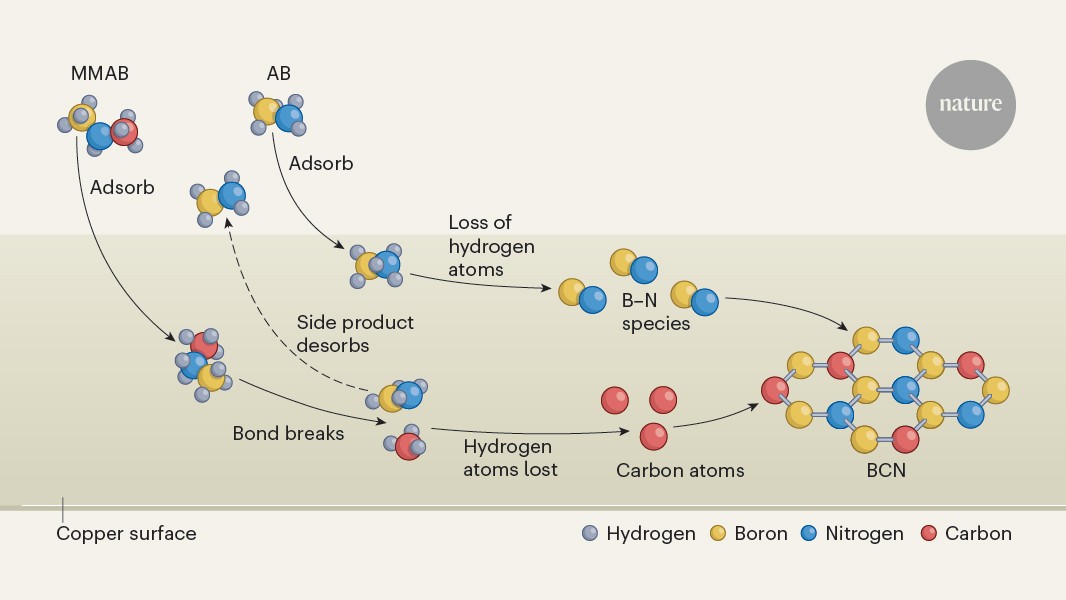
Electric currents in semiconductors arise from the movement of either negatively charged electrons or positive charge carriers known as holes. Research into atomically thin semiconductors has yielded remarkable 2D materials that efficiently transport electrons. However, identifying counterpart materials that efficiently transport holes has been much more challenging. The lack of such materials has been a considerable obstacle to the implementation of complementary 2D electronics — in which devices that use electron-transporting (n-type) 2D semiconductors are paired with equivalent devices that use hole-transporting (p-type) 2D semiconductors to improve overall performance and power efficiency. Writing in Nature, Tseng et al.1 report a semiconductor known as boron carbon nitride (BCN) that potentially fills this gap.
Access Nature and 54 other Nature Portfolio journals
Get Nature+, our best-value online-access subscription
Prices may be subject to local taxes which are calculated during checkout
Tseng, C.-C. et al. Nature https://doi.org/10.1038/s41586-026-11047-9 (2026).
Wang, Q. H., Kalantar-Zadeh, K., Kis, A., Coleman, J. N. & Strano, M. S. Nature Nanotechnol. 7, 699–712 (2012).