// NATURE NEWS — SPAZIO & SCIENZA
Type 2 immune history trains lung macrophages for viral disease tolerance
Nature
(2026) Cite this article
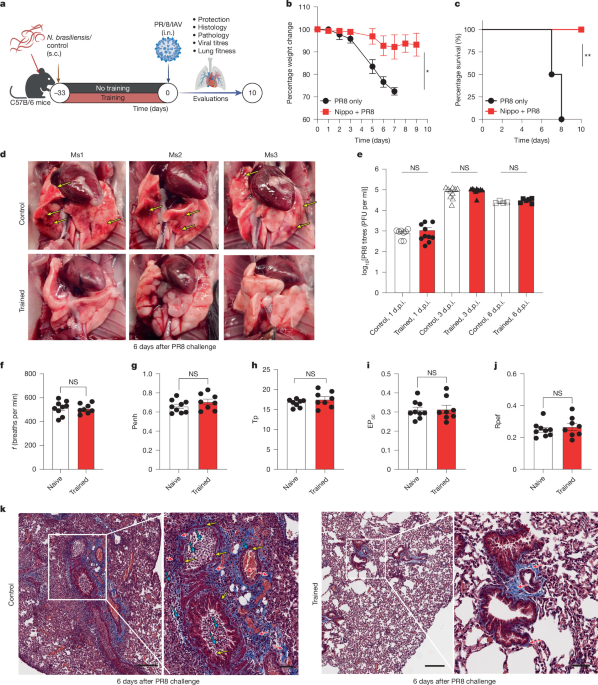
Severe respiratory viral disease varies widely among individuals and often reflects immunopathology rather than inadequate pathogen control, suggesting that previous immune history can prime the lungs towards disease tolerance. Here we show that nerve- and airway-associated macrophages (NAMs), a subset of interstitial macrophages, expand ephemerally after type 2 inflammation induced by Nippostrongylus brasiliensis. We therefore hypothesized that NAMs acquire epigenetically imprinted trained immunity and tested this using a heterologous challenge model in which mice that were previously infected with N. brasiliensis were challenged 4–6 weeks later with lethal H1N1 influenza. All of the N. brasiliensis-conditioned mice survived, whereas all of the unconditioned controls succumbed by days 5–6. Protection occurred without reduced viral burden or enhanced T cell responses, instead tracking with reduced immunopathology, amplified type 2 cues, increased efferocytosis and accelerated tissue repair. Using NAM-DTR mice, we show that conditioned NAMs are necessary and sufficient for protection: depletion or replacement with unconditioned NAMs abrogated survival, whereas adoptive transfer of conditioned NAMs conferred tolerance without enhancing viral clearance. Genomic analyses implicated an IL-4–STAT6–PPARγ and ARG1 chromatin program that imprints a pro-resolving and reparative NAM state driving tissue repair, type 2 immunity and efferocytosis during lethal respiratory viral infections. Finally, meta-analysis of human lung single-cell atlases from cohorts of healthy individuals and individuals with IPF and COPD revealed context-dependent NAM-like repair programs. These findings establish local trained immunity in lung-resident macrophages as a mechanism of disease tolerance and a therapeutic entry point for severe inflammatory respiratory infections.
An effective immune response requires balancing pro-inflammatory and regulatory signals, a task mediated by tissue-resident macrophages (RTMs) early during infections; in the lungs, RTMs refer to either alveolar macrophages (AMs) or interstitial macrophages (IMs)1,2,3. IMs comprise functionally distinct subsets defined by markers such as CD169, CX3CR1, CD206, LYVE1 and MHCII3,4,5 and chemokine expression6. We identified a CD169+ IM subset positioned around large airways and pulmonary nerves in both mice and humans called nerve- and airway-associated IMs (NAMs) that express wound-repair, immunoregulatory and efferocytosis programs3. In contrast to AMs, which undergo substantial cell death after influenza or SARS-CoV-2 infection, NAMs expand early3,7, suggesting that they may undergo epigenetic changes to acquire hallmarks of trained immunity.
Trained immunity is a durable reprogramming of innate cells through metabolic rewiring and epigenetic remodelling after an initial stimulus8,9,10,11. Most work has focused on central training, in which epigenetic changes in bone marrow (BM) precursors rewire monocytes, macrophages and neutrophils to enhance antimicrobial resistance, typically improving pathogen control12,13,14,15,16. By contrast, evidence for local trained immunity in resident macrophages that protects primarily through disease tolerance by limiting immunopathology rather than reducing pathogen burden remains limited. Disease tolerance differs from resistance in that it restrains immune-mediated damage without impacting pathogen load17,18,19,20. However, dissecting disease tolerance is inherently challenging because it requires separating tissue-protective mechanisms from effects on pathogen clearance21,22.
Here we examined whether NAMs can acquire local trained immunity to promote disease tolerance during lethal respiratory viral infection. We established a heterologous respiratory infection model by first inoculating mice with N. brasiliensis parasites, rested the mice for 4–5 weeks and then challenged them with a lethal