// NATURE NEWS — SPAZIO & SCIENZA
Spatiotemporal clonal architecture of the newborn mouse forebrain
Nature
(2026) Cite this article
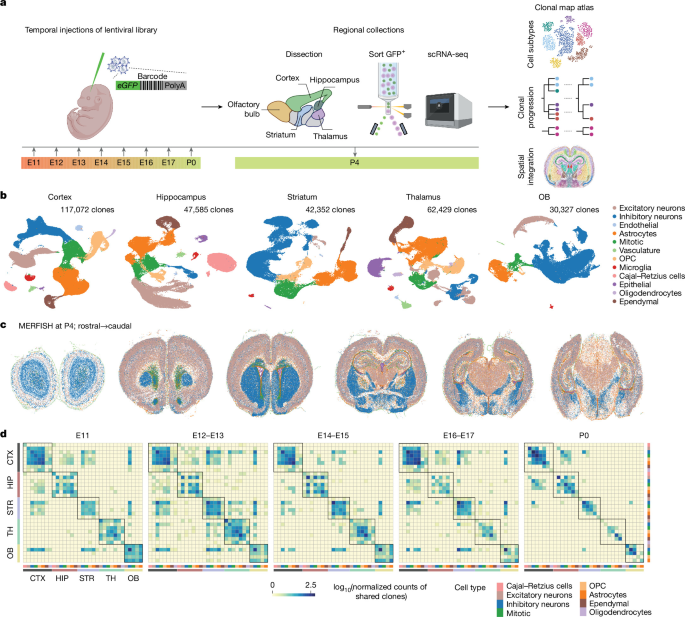
How hundreds of cell types of the mammalian forebrain emerge from a limited set of progenitor cells during development remains largely unknown1,2,3, and studies so far have overwhelmingly focused on the cerebral cortex. Here, to fill this gap, we applied lentiviral barcoding across the major subdivisions of the mouse forebrain: cortex, hippocampus, striatum, thalamus and olfactory bulb. We registered cellular profiles to their anatomical distribution using spatial transcriptomics, creating an atlas of clonal cell lineage relationships across a newborn mouse forebrain. We uncover previously unrecognized differences in generation of ventral and dorsal medium spiny neurons, as well as unexplored lineage relationships between late-born medium spiny neurons, striatal astrocytes and distinct subpopulations of the olfactory bulb neurons. We show that clones of GABAergic (γ-aminobutyric acid-producing) neurons with broad regional dispersion are enriched for genes implicated in neurodevelopmental disorders. Our results highlight a developmental principle whereby glutamatergic neurons and astrocytes are clonally related and retained within their region of origin, whereas GABAergic neurons are clonally related to oligodendrocyte precursor cells but disperse extensively across brain regions. Together, our findings will serve as a foundational reference for studies of mammalian forebrain development and its disorders.
This is a preview of subscription content, access via your institution
Access Nature and 54 other Nature Portfolio journals
Get Nature+, our best-value online-access subscription
Prices may be subject to local taxes which are calculated during checkout
scRNA-seq transcriptomic data and STICR barcode data are available at the Gene Expression Omnibus (GEO) under accession number GSE341480. An interactive browser of single-cell data and MERFISH data can be found at the University of California, Santa Cruz (UCSC) cell browser (https://p4-brain-lineage.cells.ucsc.edu). The MERFISH dataset is available at Brain Image Library (BIL; https://api.brainimagelibrary.org/web/view?bildid=ace-let-lax).
Custom codes used in this study are available on GitHub at https://github.com/NOW-Lab/STICR and https://github.com/guohua-git/p4-brain-lineage.
La Manno, G. et al. Molecular architecture of the developing mouse brain. Nature 596, 92–96 (2021).
Article
ADS
PubMed
Google Scholar